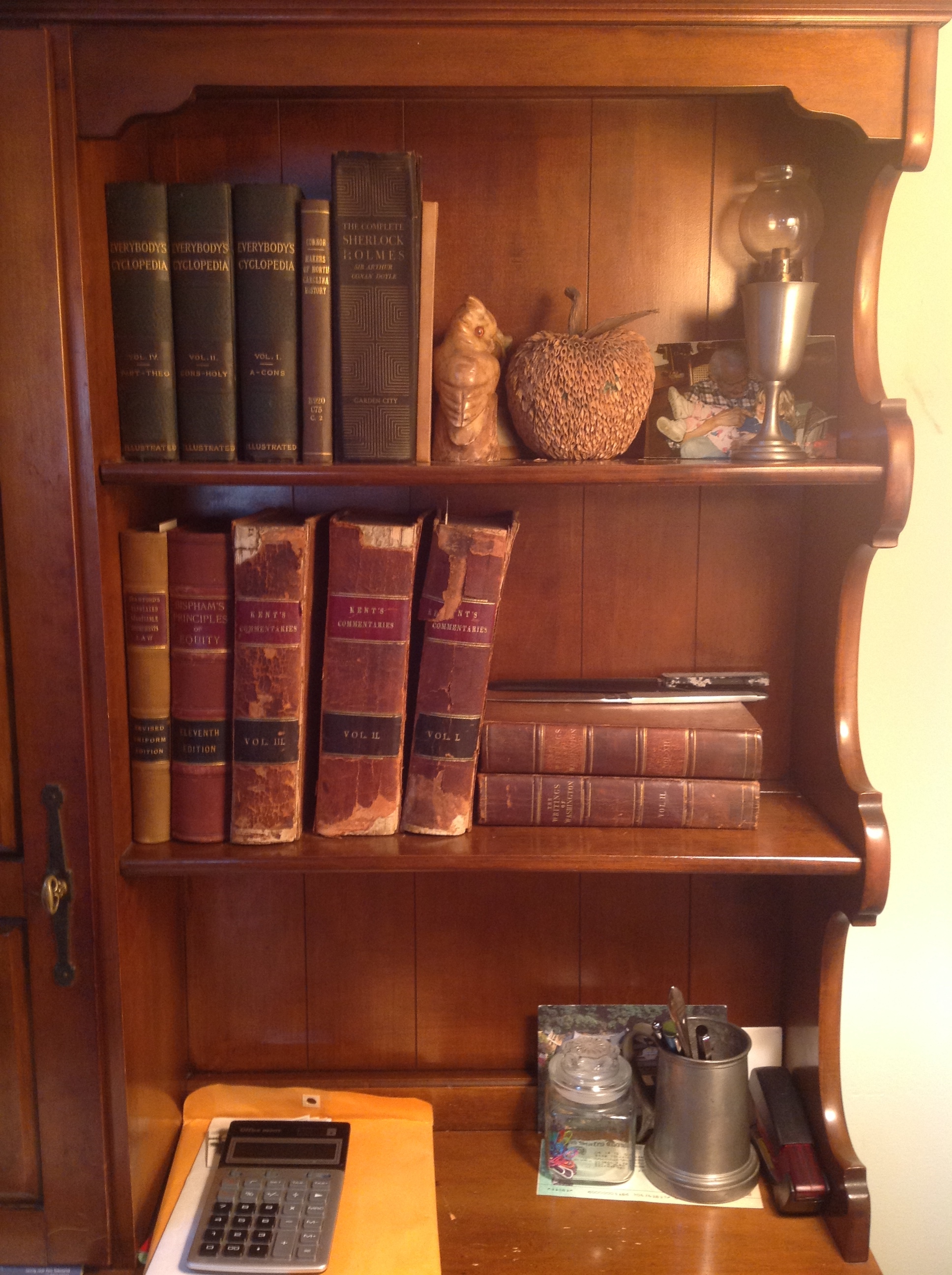
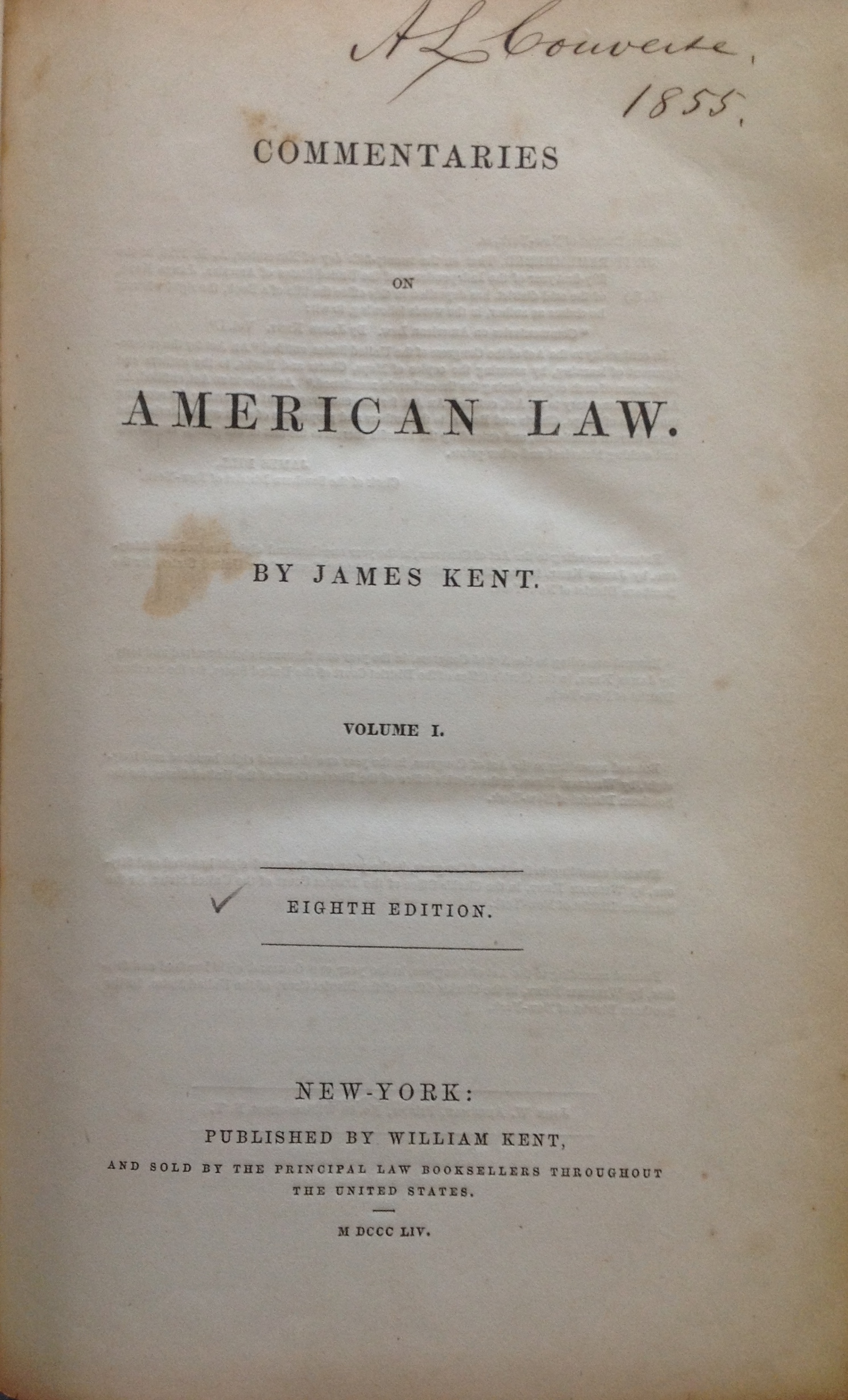
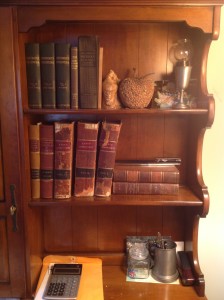
 While visiting my Dad last week, I decided to look more carefully at the law books on his desk that I’d passed by hundreds of times before. Kent’s Commentaries volumes I, II, and III caught my eye first, and when I opened the first volume, I found the original owner was none other than my great-great-great grandfather Augustus Lawrence Converse, the volumes having been signed by him in 1855 “A L Converse”.
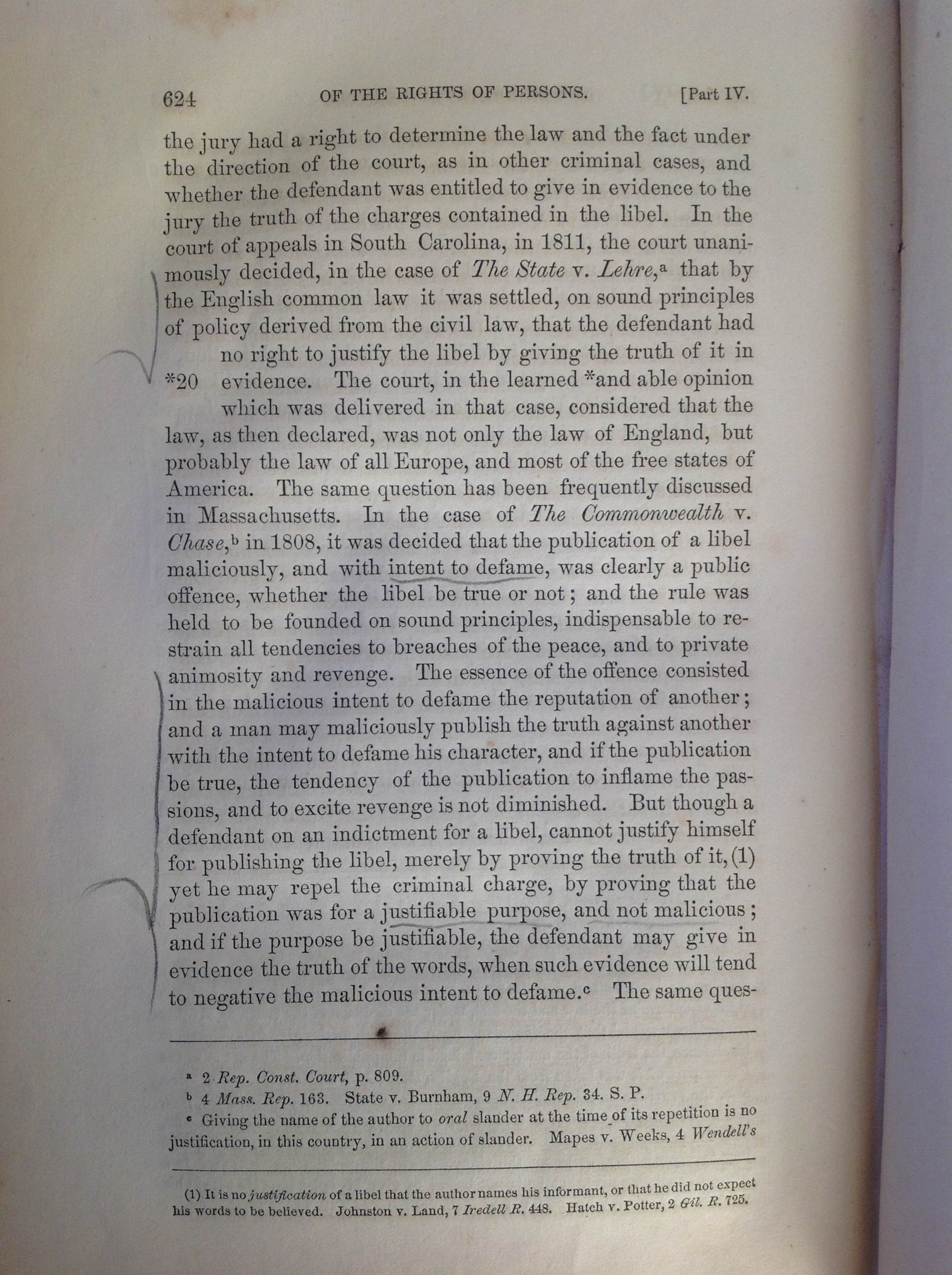
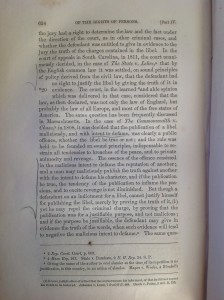
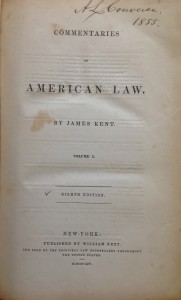 Closer inspection shows he apparently read carefully the chapter on libel and slander, underlining and marking paragraphs on several pages. The books were printed in 1854 so I wondered why a preacher would be reading new law books about libel and slander? Well, it turns out that by this time in his life, he had already resigned (or been fired?) as rector of The Church of the Holy Cross, been involved in serious legal proceedings brought against him by his second wife, Marion Singleton Deveaux, and had been defrocked by the Episcopal Church for physical attacks he had made on her! He felt he was being slandered or libeled …?
 So here’s the story as I’ve been able to discover it and its a fascinating one! The core information in this post comes from two main sources: Anne King Gregorie’s History of Sumter County (1954)) and the excellent blog entitled Kihm’s St. James’ of Skaneateles NY Blog written by Kihm Winship (akhimbo@gmail.com). Court transcripts and letters in the Singleton family papers at various libraries are most likely the primary sources for these writers but I haven’t been able to review those as yet. I also just found this recent book which contains information on the Converse/Singleton saga but I’ve yet to review it … Masterful Women: Slaveholding Widows from the American Revolution Through the Civil War, By Kirsten E. Wood, UNC Press, 2006. I hope you enjoy this story!
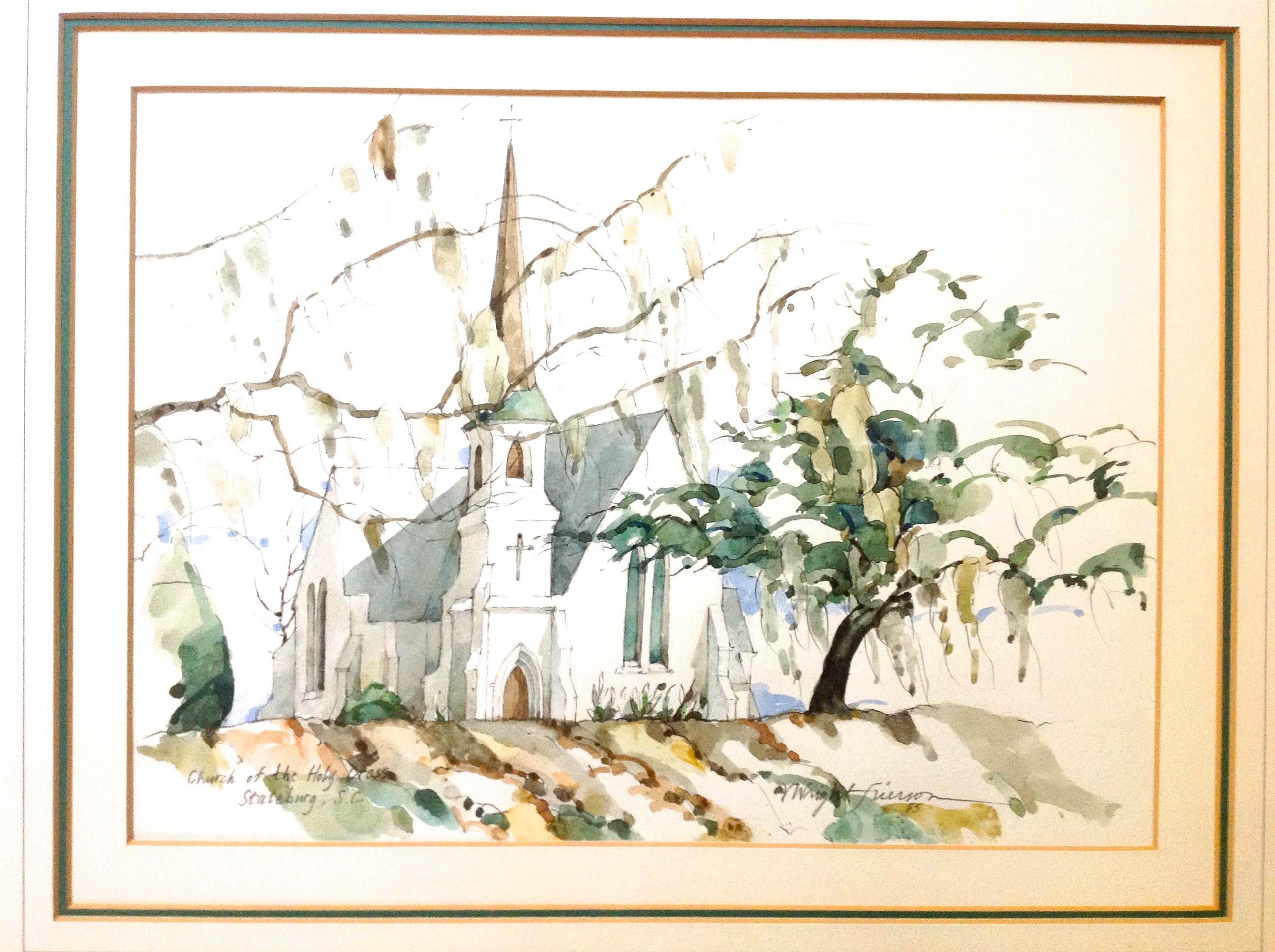
Augustus Lawrence Converse was born on November 21, 1798, in Norwich, Connecticut. The Converse family was an old New England family, the first immigrant being Deacon Edward Converse, who arrived from England to Salem, Massachusetts, in 1630 (more about this family in a later post). In 1825 Augustus married Mary Ann Kellogg of Skaneateles, N.Y., the daughter of one of the most wealthy and influential men in town, Daniel Kellogg. (In a future post I’ll tell more about his life too). A.L. Converse had graduated from Union College in 1819 and was in Skaneateles after his ordination in 1823 serving there in an Episcopal church, St.James. There he met Miss Kellogg and they married. In 1827 the couple moved to Stateburg, S.C., where he had been called as rector of the Clermont Episcopal Church (later to be rebuilt and renamed The Church of the Holy Cross). Their only daughter, Catherine Kellogg Converse (b. 7/3/1827, d. 10/7/1899), was born soon after the family arrived in Stateburg. Seventeen years later young Catherine would marry John Napolean Frierson and move down the road to Cherry Vale. A painting of the Holy Cross Church done by Virginia Wright-Frierson in 1975 is shown here. 
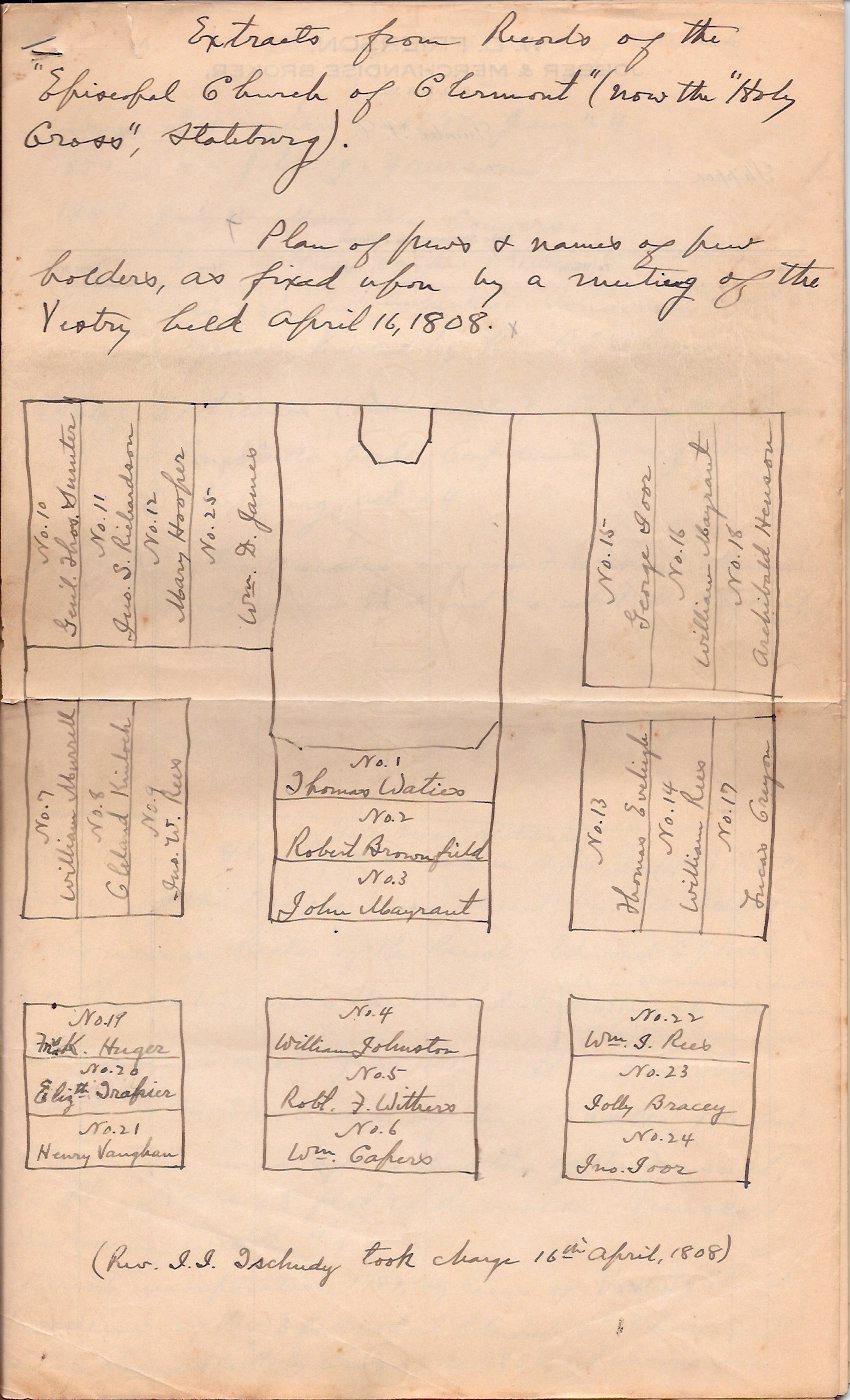
Holy Cross Church and its predecessor have played an important role in the Frierson family story over the years and J. Nelson Frierson wrote a history of the church I think in connection with an article he published in 1909 in The State newspaper on the town of Stateburg. He extracted many family references from the records of the old and new churches and the first page of his work is shown here (it’s a 20 page document!).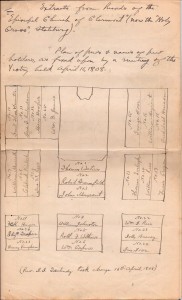
In these records, it is seen that Rev. Converse seemed to be performing his duties in a creditable way- baptisms, funerals, and weddings – the most impressive wedding must have been in 1838 when at the Singleton plantation “Home House” he performed the marriage of young Angelica Singleton (sister of his future second wife Marion) to Abraham van Buren, eldest son of the sitting President of the United States, Martin van Buren. The Extracts do seem to show an inordinate number of entries relating to the Rev. Converse’s salary and compensation! – he seems to have been on an annual contract!
The Converse-Frierson wedding on May 2, 1844, between Catherine Converse and John Napolean Frierson was performed by the Rev. C. E. Gadsden. According to the Extracts, on November 21, 1847, Rev. Converse performed a “private” baptism of his wife Mary Ann Kellogg Converse “in her last illness, with Mrs. Julia Frierson [mother of John Napolean Frierson] and Mr. and Mrs. Jno N. Frierson [John Napolean and Catherine], witnesses.” She died on January 8, 1848, and her husband performed her funeral service and burial on January 11, 1848. In fact he performed a double funeral on that day: Under “Burials”, Uncle Nelson wrote in the Extracts… “1848 Jan. 11 – Mary Ann Converse and Henry Vaughan Frierson in the same coffin” . Henry Vaughan Frierson, their third grandchild, was born in 1847 and lived less than one year.
In almost exactly one year to the day, Rev. Converse remarried (from the Extracts: “ 1849, Jan.15, by the Rev. Peter J. Shand“), again to a wealthy woman, this time the widow Marion Singleton Deveaux, and it is here that the real story begins….Marion Singleton was the daughter of the wealthy planter Colonel Richard Singleton of Stateburg and when her first husband Robert Marion Deveaux died in 1843, it was said that the Rev. and Mrs. Converse comforted the widow and her family during this sad time. Marion S. Deveaux not only inherited the plantation called “The Ruins” from her husband, but had large land holdings given her in trust by her father. Upon her marriage to Rev. Converse, he initially signed a “prenuptial” agreement that her lands would pass to her children should she die first, but later that agreement was changed at his insistence apparently. I’m going to quote now from “Kihm’s St. James’ Blog” (link given here: http://kihm3.wordpress.com/2011/12/11/when-rectors-attack/ ) since it tells the story so completely…
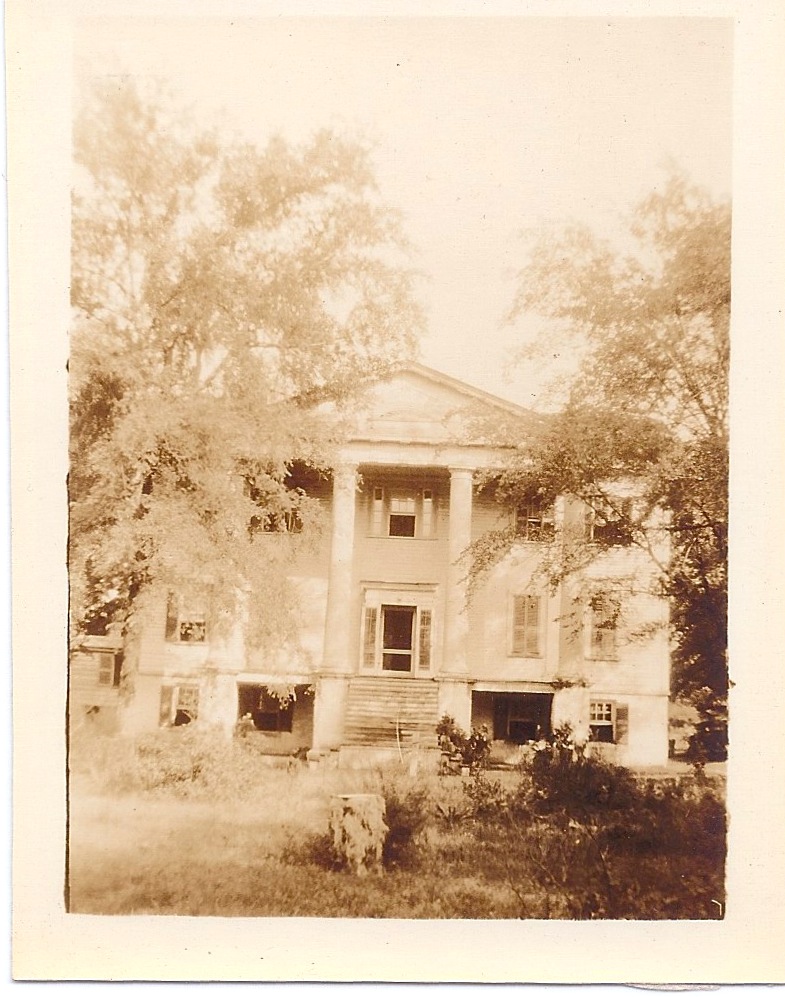
“The following year (1849) the Rev. Converse married a widow from his parish, Marion Singleton DeVeaux. She was 18 years his junior, and her family warned her that this was not a good match. But the Rev. Converse and his wife Mary Ann had been a great comfort to Mrs. DeVeaux during her husband’s final illness in 1843, and she went ahead with the marriage. The Rev. Converse and his new bride would live at her plantation, The Ruins, on a hill near the church where Converse presided. The Ruins, named for its condition when the Singleton family first took possession, had been restored and was now said to be as lovely as a French chateau.
From her father, a cotton planter, Marion had inherited land holdings which by law remained hers when she married, and were to be passed down to her children. Her first husband had agreed to this arrangement. Initially, the Rev. Converse also acquiesced. A prenuptial agreement, signed by both parties, put Marion’s property into the hands of trustees to be held for her; the land would return to her upon the death of Augustus Converse, or to her children should she die before him. But soon after the marriage, at her husband’s insistence, Mrs. Converse signed a deed giving her husband a share of the property, which he would have for life if he survived her.
In 1850, the Rev. Converse laid the cornerstone for a new church to be known as the Church of the Holy Cross. The church was consecrated in 1852. But as Mary Elizabeth Beauchamp noted in her Recollections of the Parish of St. James, Skaneateles, the Rev. Converse had “practically changed the duties of his sacred calling for the care of his plantation.” In April 1853, a church committee reported: “Resolved, that Mr. Converse’s resignation be accepted.”
At this point, the Rev. Converse’s transformation accelerated. Freed from his church duties and having obtained the upper hand at home, he became more and more tyrannical. To escape, Marion went on long visits to relatives in New York, Philadelphia and Virginia as well as South Carolina. The general feeling among Marion’s family was that Converse was a sanctimonious, short-tempered scoundrel. One aunt summed it up neatly, referring to Converse as “that grasping bad evil Man.” But Marion eventually had to return to her home and Converse was in it.
In January of 1854, infuriated because Marion would not submit to his wishes, he forced her into his room, locked the door behind them, and began loading his gun. Marion ran out onto a terrace and jumped ten feet to the ground below, where slaves, who had been drawn by screams and shouting, hurried her to their quarters.
Soon after, Converse punished the slaves for sheltering his wife and then gave his wife a “prolonged beating.” The accounts do not say if he used his fists or his cane, but the result was that Marion, bruised and bleeding, again fled from her home, this time with the help of one of her daughters, and took refuge in a cotton-house. The Rev. Converse, pursuing the two women there, called for a hammer and nails to seal them inside. Hearing this, the mother and daughter ran out into the cotton fields and hid. The weather was cold; it was pouring rain, and apparently the Rev. Converse, with his wooden leg, was unable or unwilling to give pursuit.
Again, it would seem, one or more of the slaves interceded. A neighbor was summoned, found the women in the field, and led them to safety across a river to another plantation.
At a safe distance from his rage, Marion began legal action to separate from her husband, to resume her first husband’s name and regain her land. In court, the Rev. Converse testified that he could not reconcile himself to a situation in which “all his rights as a husband were subordinate to her claim.” He said she undermined his authority with the slaves. He accused her family of “unwarrantable interference in his domestic concerns.”
The court – supporting the rights of a man, husband and slave holder – ruled against Marion; the Rev. Converse retained control of The Ruins and his wife’s property.
Marion appealed to a higher court and lost again, but this time at least the court did order the Rev. Converse to give his wife half the income from her land. And the judge, in an aside, referred to Converse’s behavior as “revolting.”
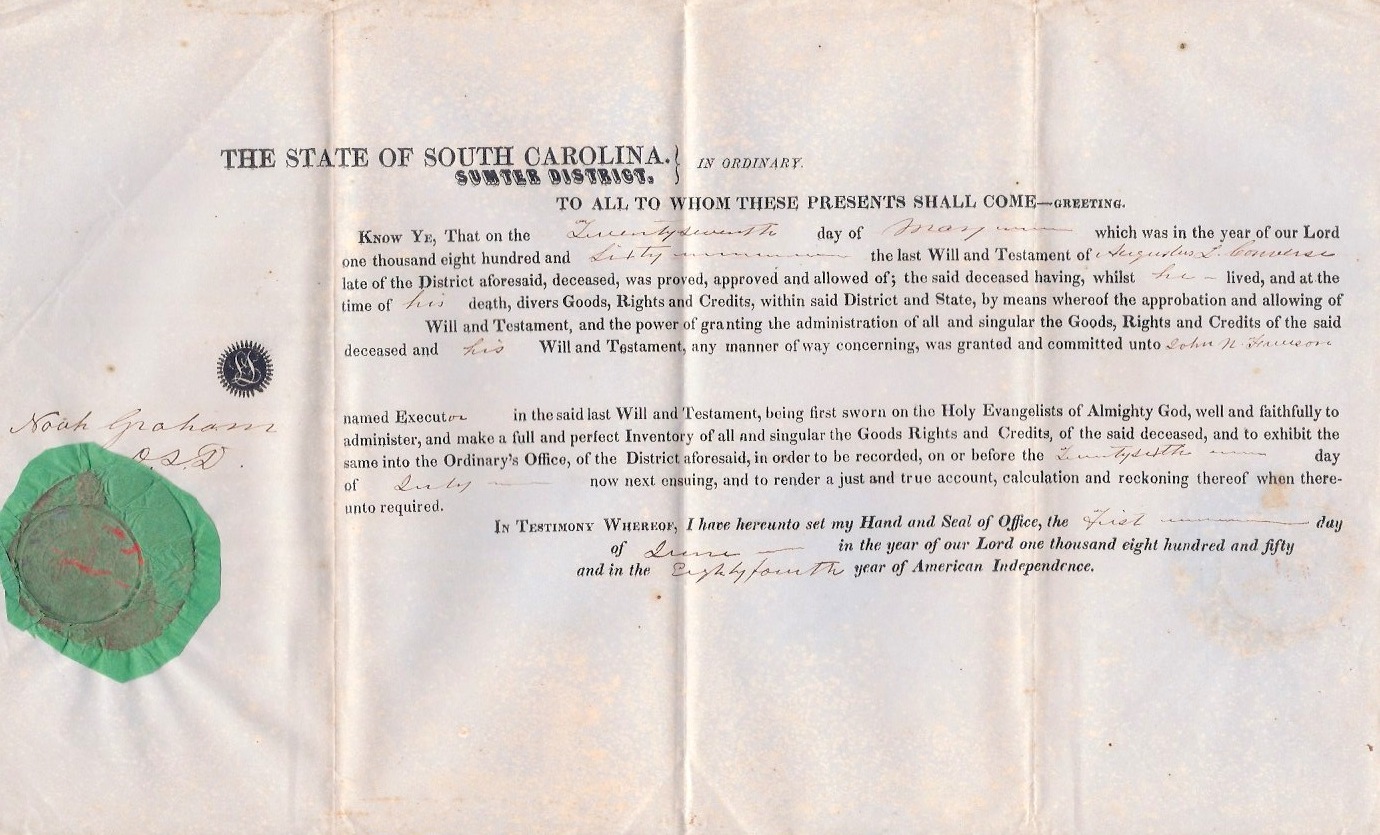
In 1855, a much higher court gave its opinion: The Episcopal Church defrocked Converse for the “Unprovoked and Cruel beating” of his wife.
Finally, in 1857, a legal settlement was reached. Augustus Converse took $24,250 – a huge sum raised by Marion’s family and friends – in return for vacating her home and renouncing all claims to her estate. Marion and her youngest daughter returned to The Ruins to live; Marion dropped the name of Converse, and lived the rest of her life as though A.L. Converse had never existed. Her oldest daughter and her son-in-law lived at The Ruins for part of the year to help her manage the estate. In Marion’s will, she specified that her property was to go to her daughters for their “sole and separate use” during their lifetimes. She would not allow her daughters to suffer as she had.
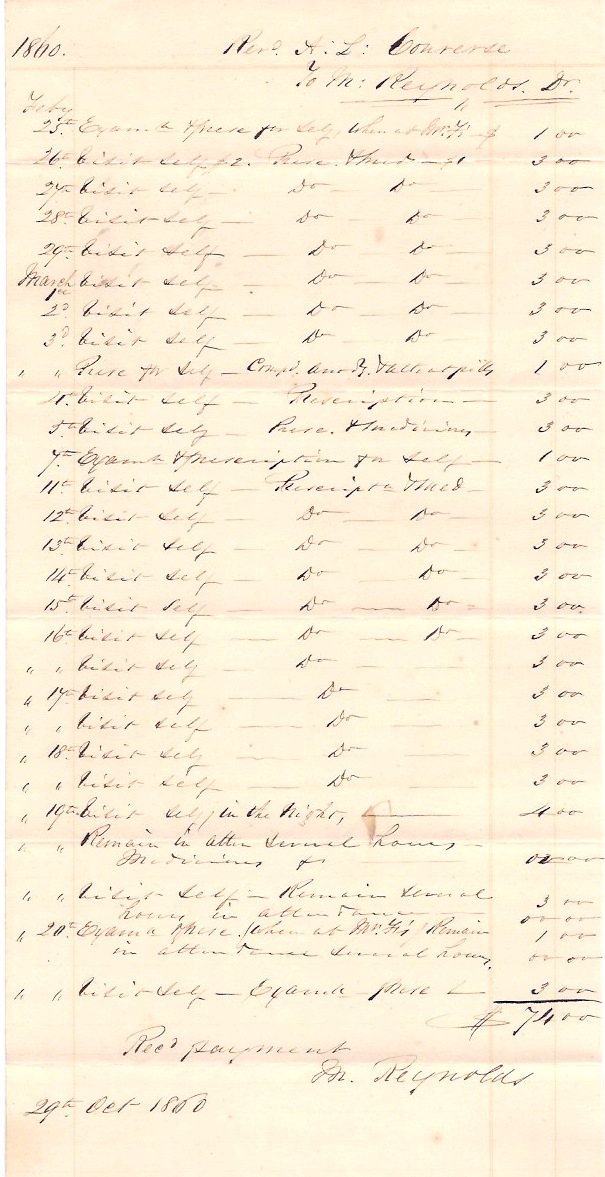
In 1860, after three years of counting his money and living as a social pariah, Augustus L. Converse died. He was buried in the churchyard of the Church of the Holy Cross.”
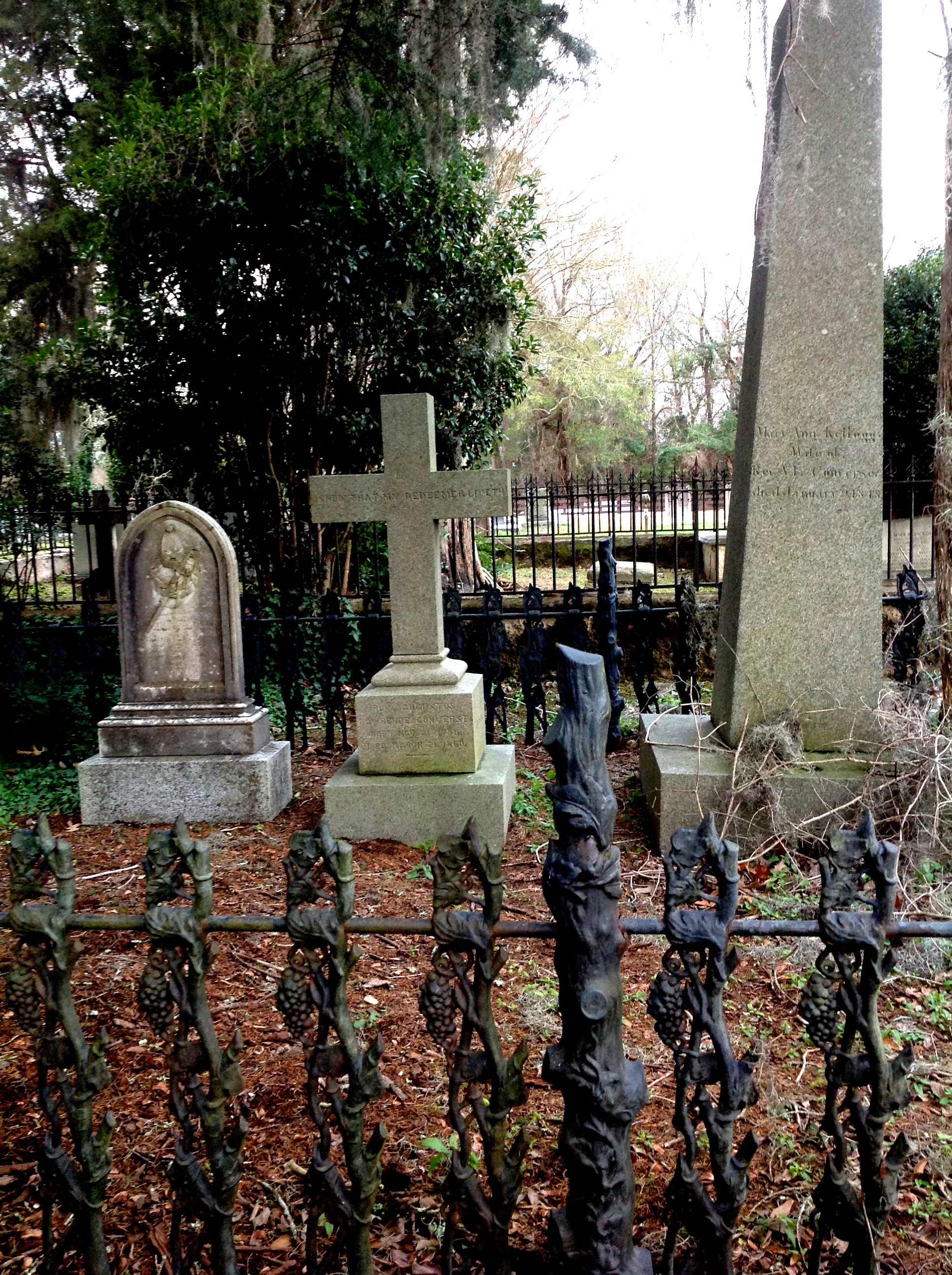
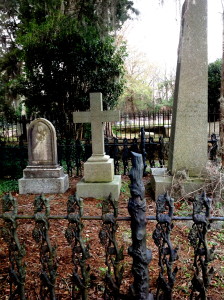 According to the Extracts of Records by J. Nelson Frierson, the Reverend P. J. Shand performed A. L. Converse’s funeral on March 23, 1860. His tombstone (the cross in the center of the three) is shown here in the Frierson-Vaughan enclosure at Holy Cross Church, alongside the one for first wife, Mary Ann. Hers is the tall obelisk at the right.
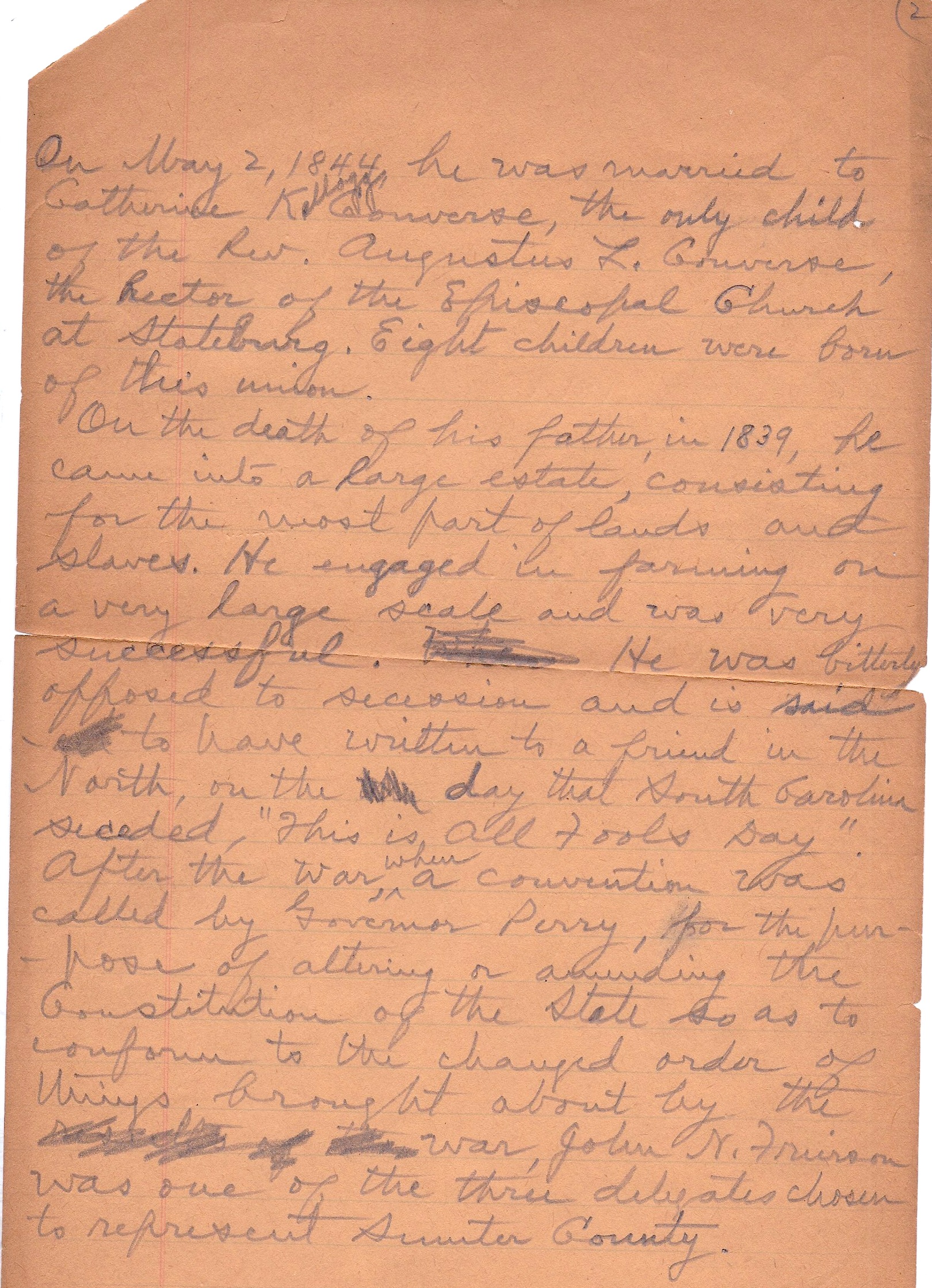
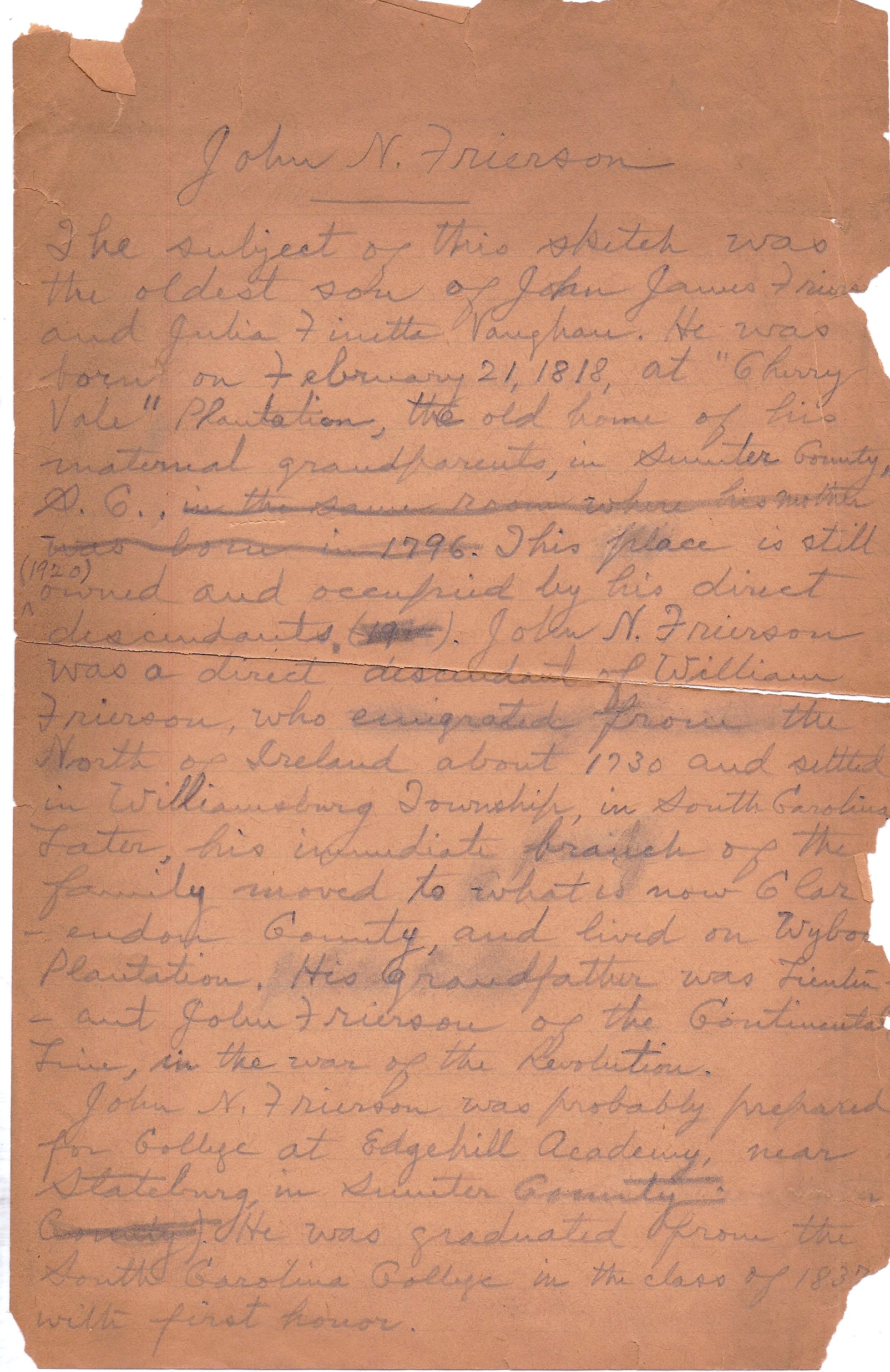 The papers are brittle and yellowed as you can see to the right. The sketch was written in 1920, and though it contains previously known information (some correct and some incorrect!), this is the first time I’ve seen it written that Napolean was not at all in favor of the secession of South Carolina from the Union in 1861. The incorrect statement concerns his so-called “direct ancestor” William Frierson – our branch of the Friersons is not directly descended from the William referred to here by Nelson. More about this mistake later… I’ll retype the sketch here: