I just found a two-page, handwritten sketch about John Napolean Frierson written by his grandson, James Nelson Frierson. 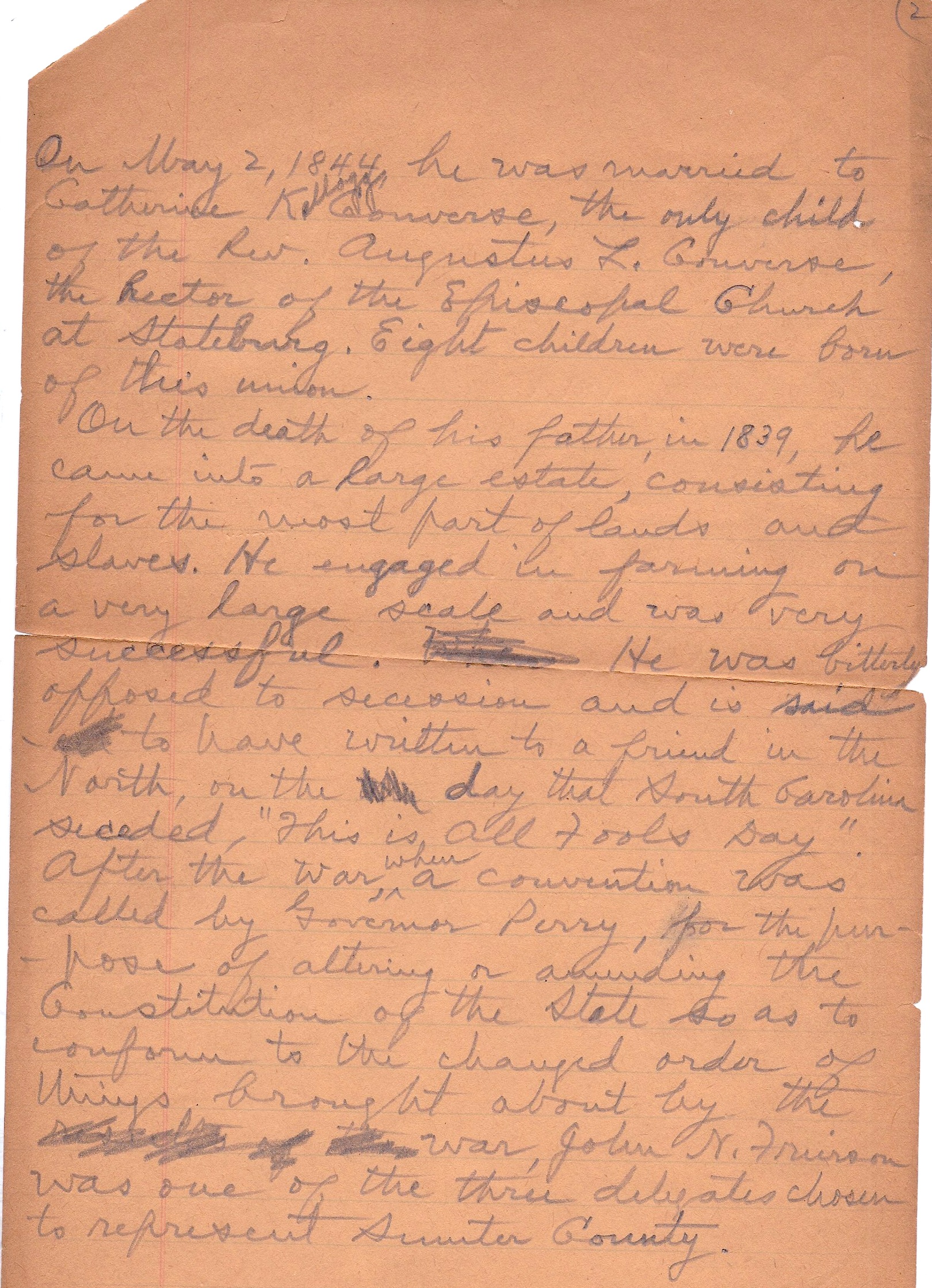
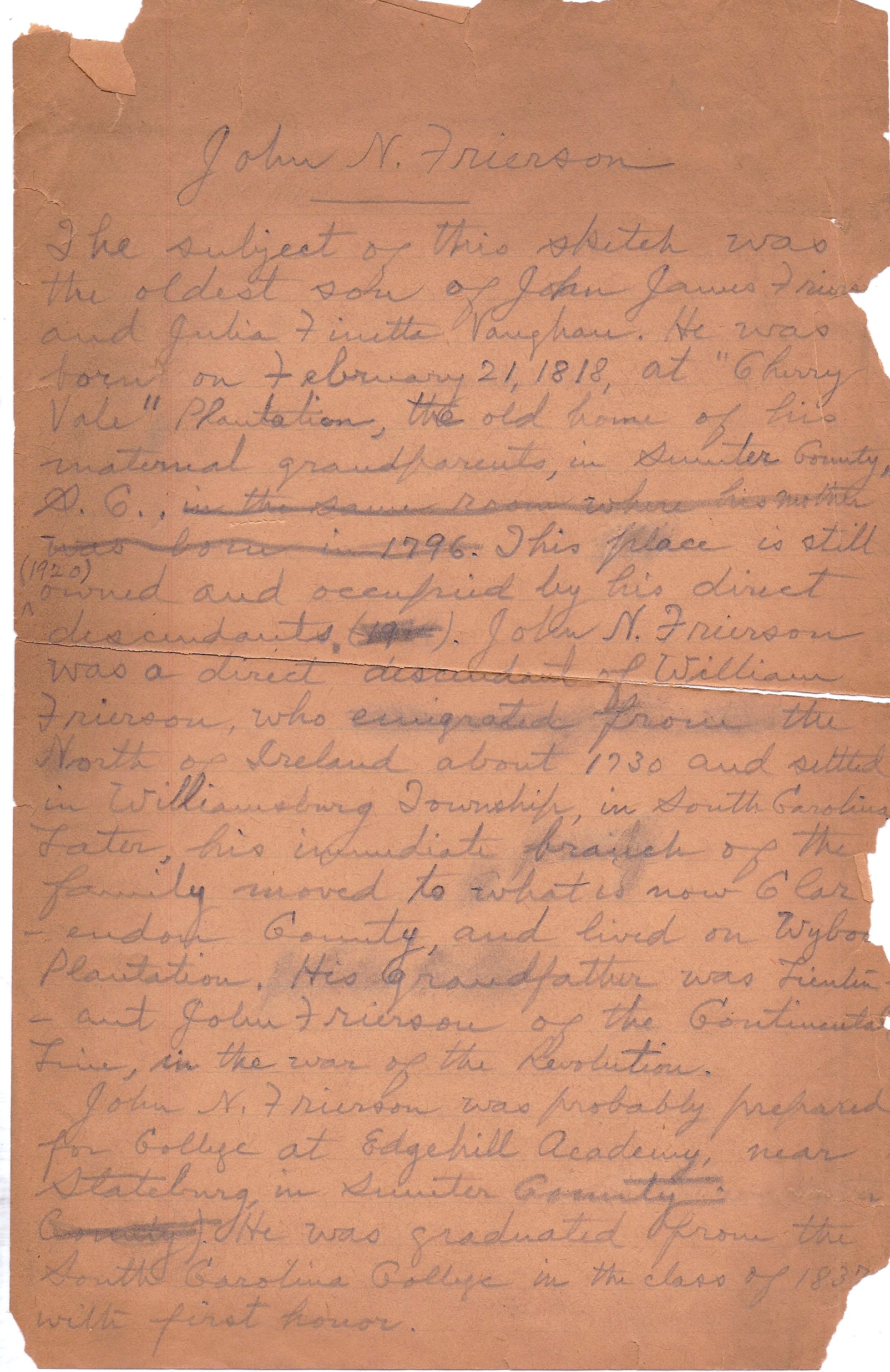 The papers are brittle and yellowed as you can see to the right. The sketch was written in 1920, and though it contains previously known information (some correct and some incorrect!), this is the first time I’ve seen it written that Napolean was not at all in favor of the secession of South Carolina from the Union in 1861. The incorrect statement concerns his so-called “direct ancestor” William Frierson – our branch of the Friersons is not directly descended from the William referred to here by Nelson. More about this mistake later… I’ll retype the sketch here:
John N. Frierson
The subject of this sketch was the oldest son of John James Frierson and Julia Finetta Vaughan. He was born on Fegruary 21, 1818, at “Cherry Vale” Plantation, the old home of his maternal grandparents, in Sumter County, S.C. (Scratched out: “In the same room where his mother was born in 1796”). This place is still (1920) owned and occupied by his direct descendants. John N. Frierson was a direct descendant of William Frierson who emigrated from the North of Ireland about 1730 and settled in Williamsburg Township, in South Carolina. Later, his immediate branch of the family moved to what is now Clarendon County, and lived on Wyboo Plantation. His grandfather was Lieutenant John Frierson of the Continental Line, in the War of the Revolution.
John N. Frierson was probably prepared for College at Edgehill Academy near Stateburg in Sumter County. He was graduated from the South Carolina College (now the University of South Carolina) in the class of 1837 with first honor. On May 2, 1844, he was married to Catherine Kellogg Converse, the only child of the Rev. Augustus L. Converse, the Rector of the Episcopal Church at Stateburg. Eight children were born of this union.
On the death of his father in 1839, he came into a large estate, consisting for the most part of lands and slaves. He engaged in farming on a very large scale and was very successful. He was bitterly opposed to secession and is said to have written to a friend in the North, on the day that South Carolina seceded, “This is All Fools Day”. After the War, when a convention was called by Governor Perry, for the purpose of altering or amending the Constitution of the State so as to conform to the changed order of things, brought about by the war, John N. Frierson was one of the three delegates chosen to represent Sumter County.