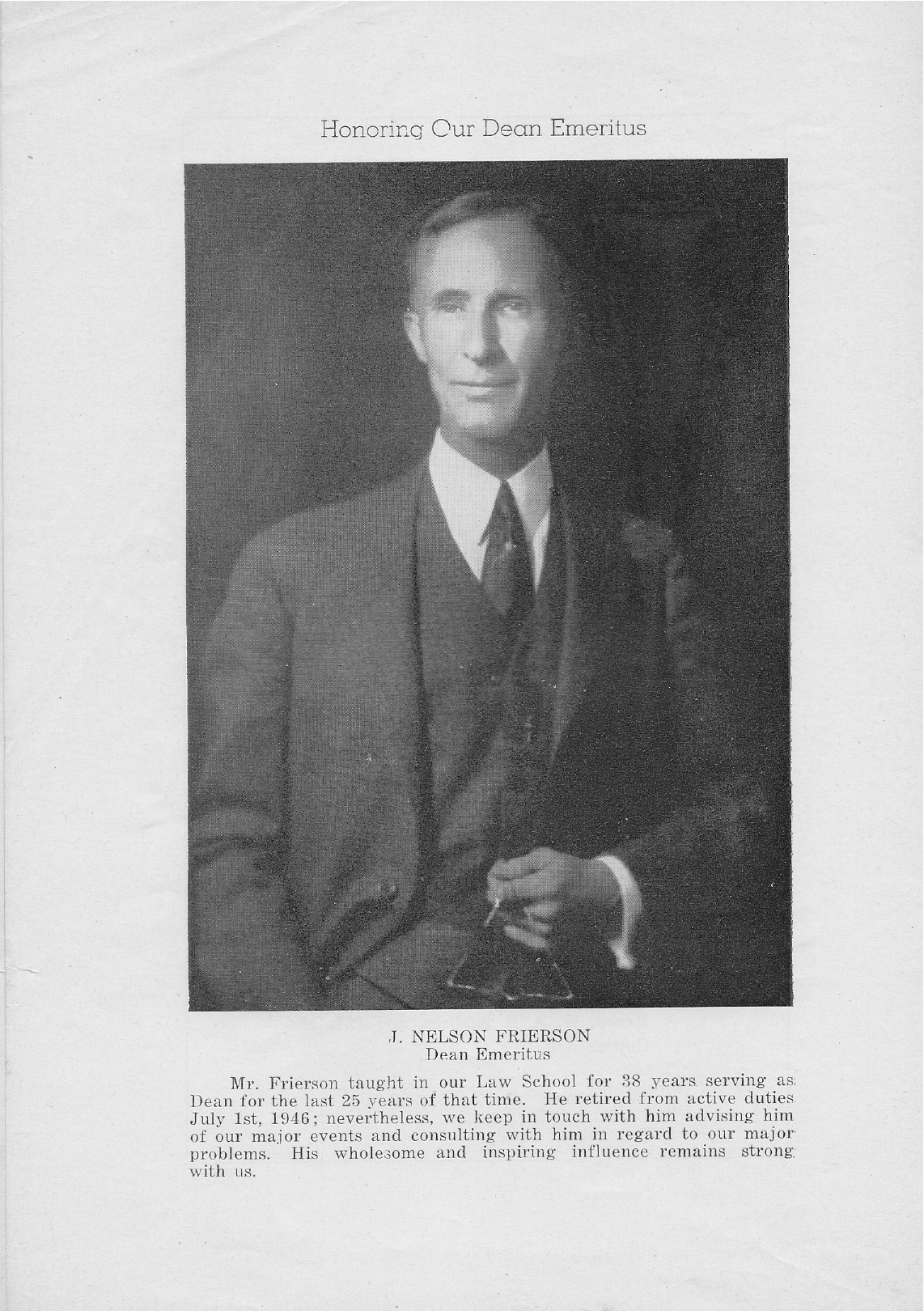
Our Frierson family has been in South Carolina since at least the mid-eighteenth century. The land grant shown below from King George III of England to James Frierson in 1765 grants him “250 acres situated in St. Mark’s Parish on the North side of Santee River on Titus Swamp, Dents Swamp, and Camps Branch Bounded to the West part on William Robertson and part on vacant land”.
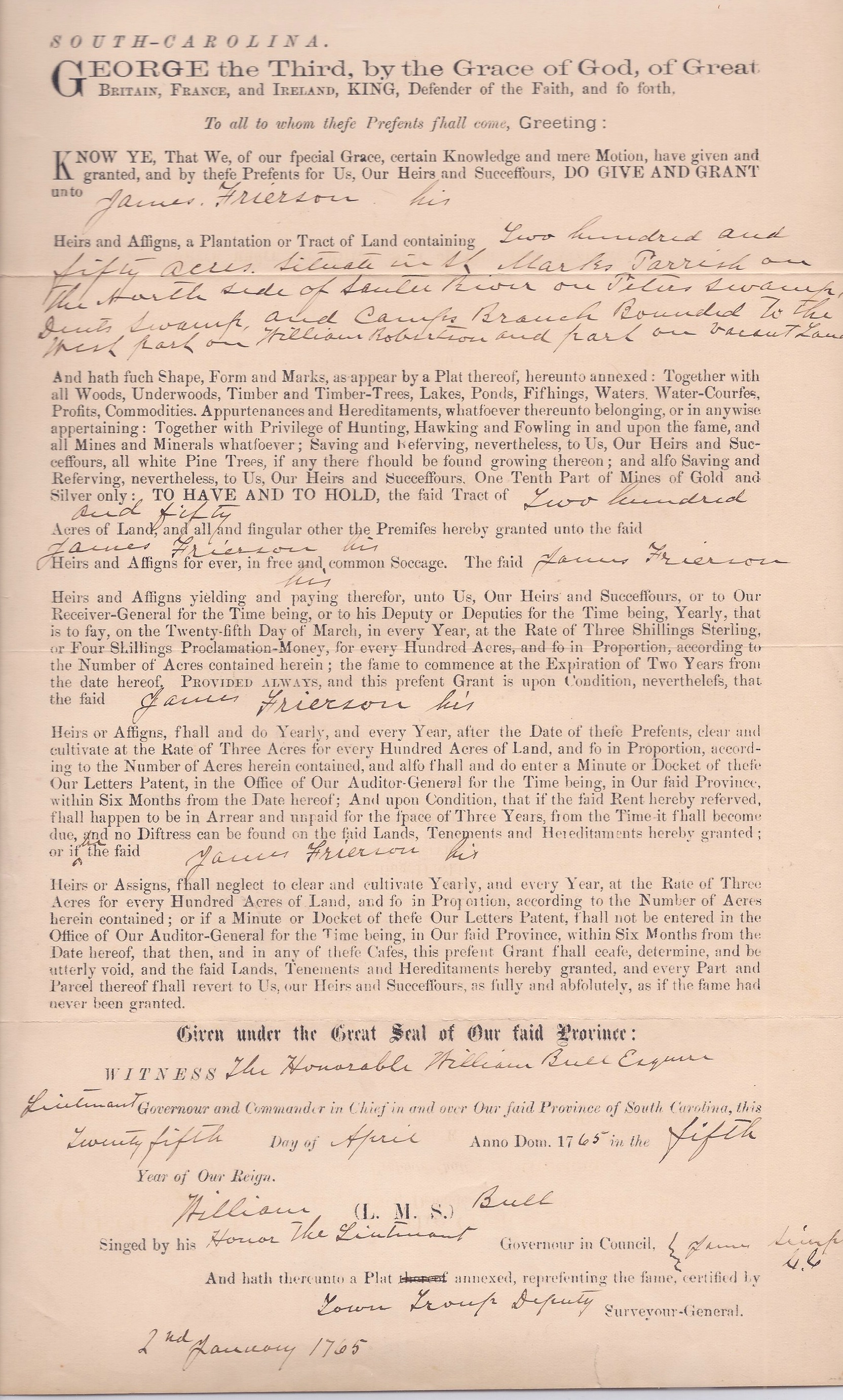
Land Grant to James Frierson, April 25, 1765
This James Frierson (d.~1785) is my great-great-great-great-great grandfather and his property is very likely part of the land that in the early 1940’s was inundated by the Santee Cooper Project which built hydroelectric dams to form Lakes Marion and Moultrie and bring electricity to several of the counties in this part of South Carolina. Lake Marion is fed by the Santee River and Wyboo Creek and others and now covers acres of property owned by some of the earliest settlers of SC, including the Friersons.
In the late 1930’s and early 1940’s, as the hydroelectric project was being planned, surveys were made of the historic homes to be destroyed by the lakes (see the Waterman report from 1939 at http://www.rootsweb.ancestry.com/~scbchs/Waterman.html and the article by F. M. Kirk on plantations to be flooded at http://www.rootsweb.ancestry.com/~scbchs/plantation5.html ). 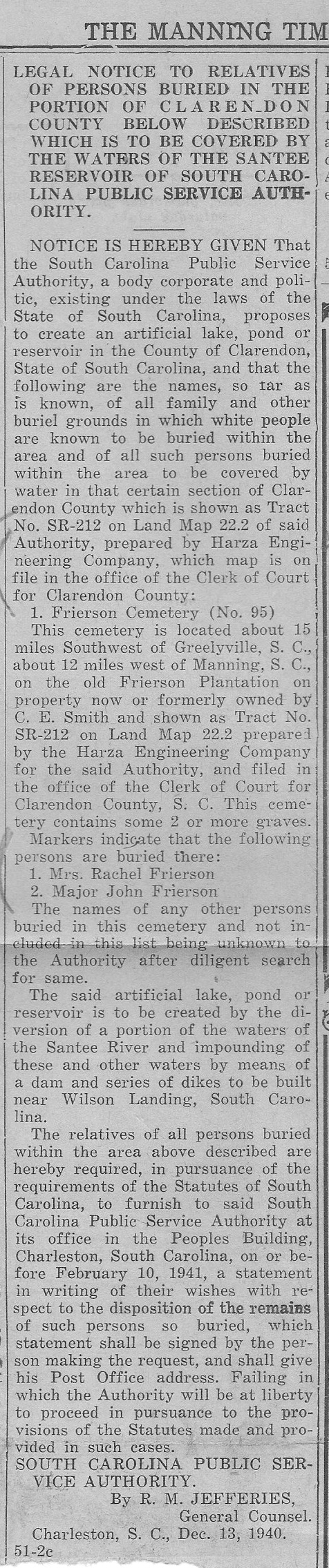 Along with flooded homes, it was realized that many cemeteries would also be covered by lake waters and attempts were made to find nearest kin who might have interests in the graves. Starting in 1938, letters of James Nelson Frierson, (Uncle Nelson of the previous post below) show his interest in a particular graveyard attached to the old Wiboo Plantation formerly owned by ancestors of our Frierson family. As the Santee Dam neared completion, the SC Public Service Authority began advertising graveyards that would be affected by the rising waters. One such notice is shown to the right from the Manning Times of December 25, 1940.
Nelson’s first and most descriptive letter on the subject of these graves is written to Mrs. Waites Rees (nee Julia Vaughn Frierson ( 1859-1944)). She was the daughter of Nelson’s great-uncle James Julian Frierson (1832-1899). James Julian Frierson was the younger brother of John Napolean Frierson (1818-1887), my great-great grandfather and these two planters owned much property in Sumter/Clarendon County. Nelson describes in this letter, written on July 21,1938, a visit he made to the old graveyard as follows:
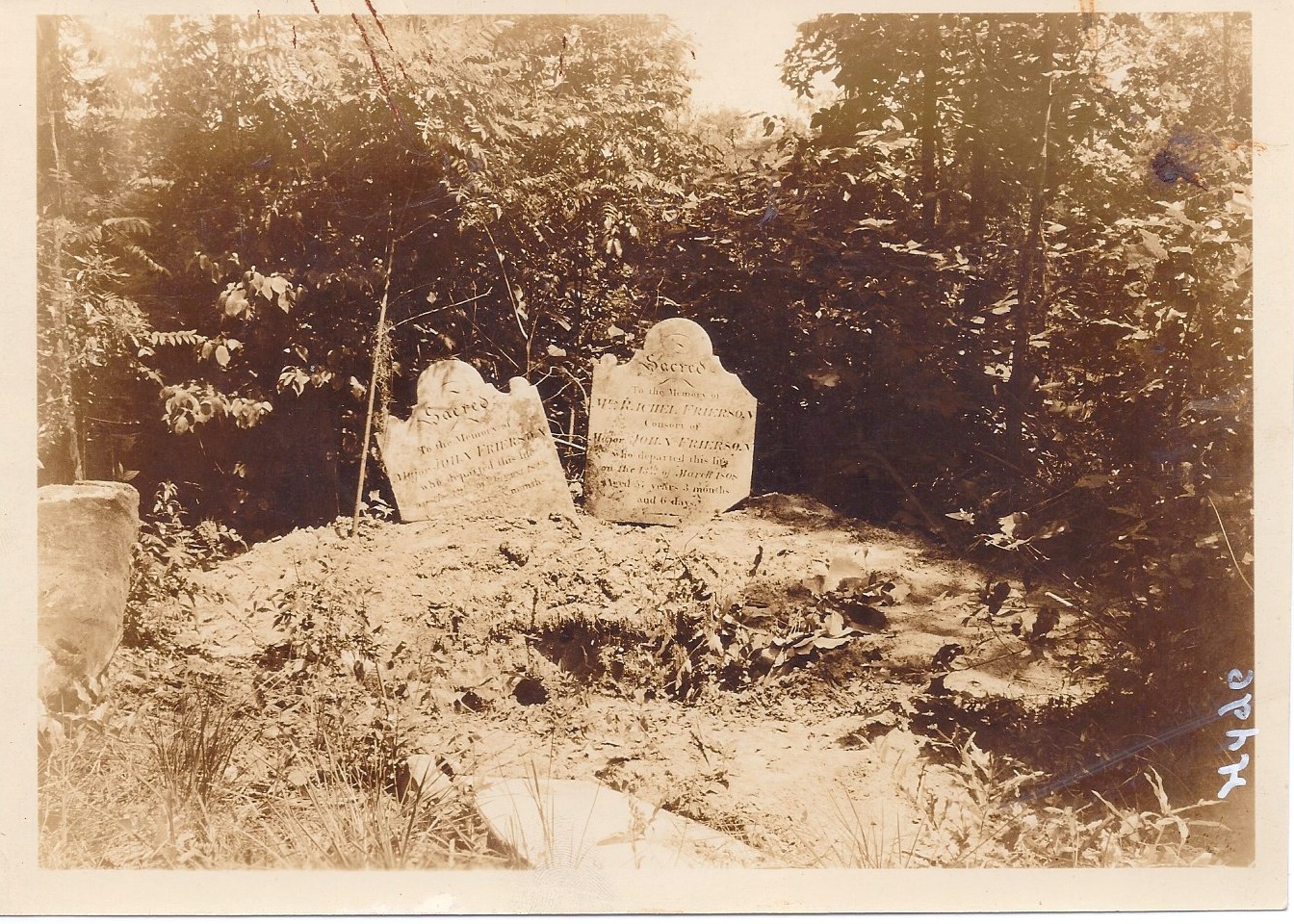
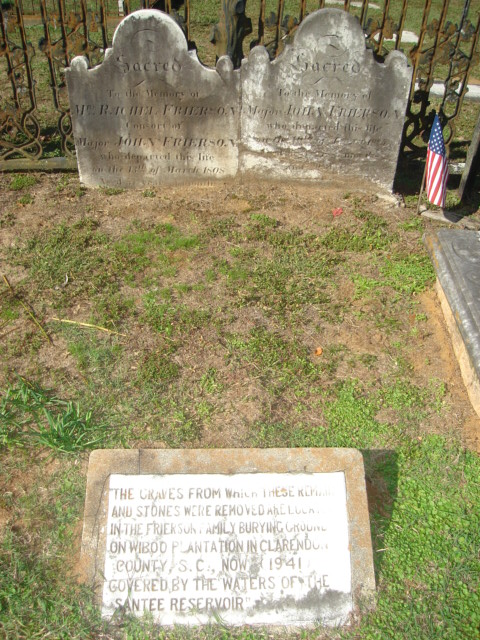
Tombstones in Frierson graveyard, Wiboo, 1939
Photo by S. L. Hyde of Santee-Cooper Authority
“My dear Cousin Julia: Last Sunday, July 17th, at his request, I accompanied my brother John Frierson (John Lawrence Frierson (1883-1963), my grandfather, we called him “Papa”) down to view the old Frierson graveyard in the swamp back of Wiboo. John’s oldest son, Jack (John Lawrence Frierson, Jr. (1915-1994), my “Uncle Jack”), and also John’s brother-in-law, Oliver Plowden (“Uncle Oliver”), accompanied us on the trip. It was a very hot day but we felt well repaid for our troubles. We first drove by Wiboo place and I was much saddened to see only the three gaunt chimneys standing of the old house in which I visited in the late fall of 1890. … When we got to the old graveyard we found only two gravestones. There were apparent evidences of other graves having been there but there were no other stones, and the two that we found were broken and lying on the ground. The graveyard is surrounded by an old ditch and consists of about a quarter of an acre. A very old live oak tree stands in the middle of the enclosure, but it is a mere shell, gutted by fire and will not be standing very long. I copied the two inscriptions and they read as follows: ‘Sacred to the Memory of Major John Frierson who departed this life on the 10th day of August 1825 Aged 68 years ? months and ? days’ (the number of months and days are obliterated on the stone). ‘Sacred to the memory of Mrs. Rachel Frierson Consort of Major John Frierson who departed this life on the 13th of March 1808 Aged 57 years 3 months and 6 days’.
I do not know whether the old graveyard will be covered with water after the lake to be formed under the Santee-Cooper project shall have filled or not. But I am convinced that if the land will not actually be covered with water, it will undoubtedly be surrounded with water so as to be inaccessible. Under these circumstances I think that it will be very fitting and proper to have these two broken tombstones removed to the old Frierson enclosure at the rear of the Church of the Holy Cross in Stateburg and have them set up there, with perhaps an accompanying statement to the effect that ‘the graves from which these stones were removed in the month of —, 1938 are in the old Frierson burying ground on Wiboo plantation, Clarendon County, South Carolina’.
Holy Cross Church, 2006
If this is done, the stones in the one enclosure at Stateburg will show an unbroken line from Major John Frierson of the Revolution down to the present time. What are your views and wishes concerning ther removal of the two stones? My hope is that we may be able to get the Santee-Cooper Authority to bear the expense of removing the tombstones from their present location to the Church at Stateburg and perhaps bearing the expense of setting them up there. I sincerely hope that you and Honor and all her children are well and that I may have the happiness of seeing you before very long. With love to yourself and Honor and hoping to hear from you soon, I remain Your affectionate cousin, J. Nelson Frierson.”
By the time the Santee dam was completed in 1941 and the river began to flood the area, the graves had been moved to the Frierson-Vaughn enclosure in the Holy Cross Church in Stateburg, S.C., and they remain there today as you can see from the photo above.
Major John Frierson (1757-1825) and Rachel Davis McDonald Frierson (1751-1808) are my great-great-great-great grandparents. He was the oldest child of the original grantee James Frierson and was commissioned in 1779 as Lieutenant in the Second South Carolina Regiment of the Continental Army. His commission is shown here, signed by John Hanson of Maryland, first president of the Continental Congress.
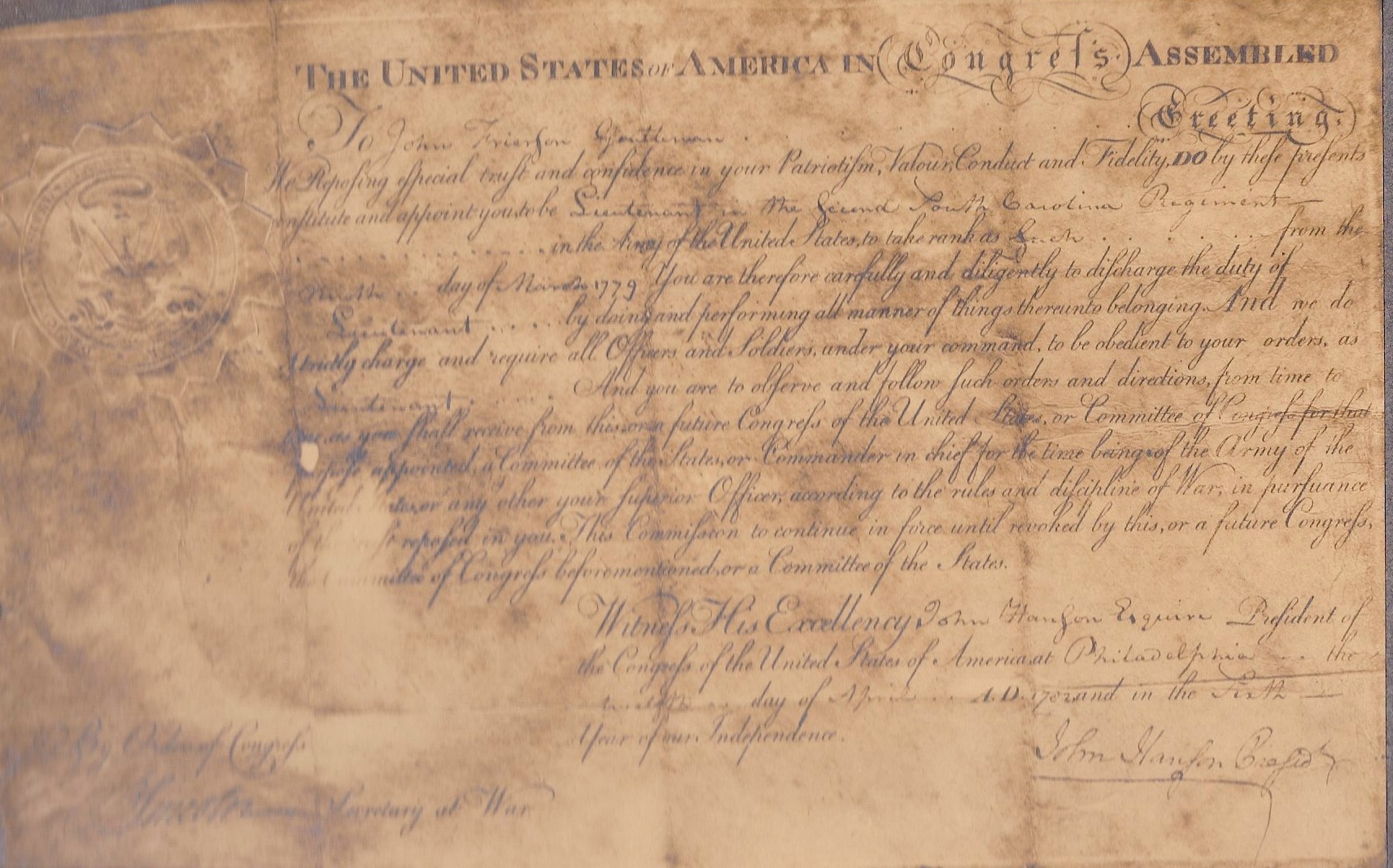
John Frierson’s Commission as Lieutenant in the Second SC Regiment of the Continental Army