Category Archives: Frierson Family

War talk…


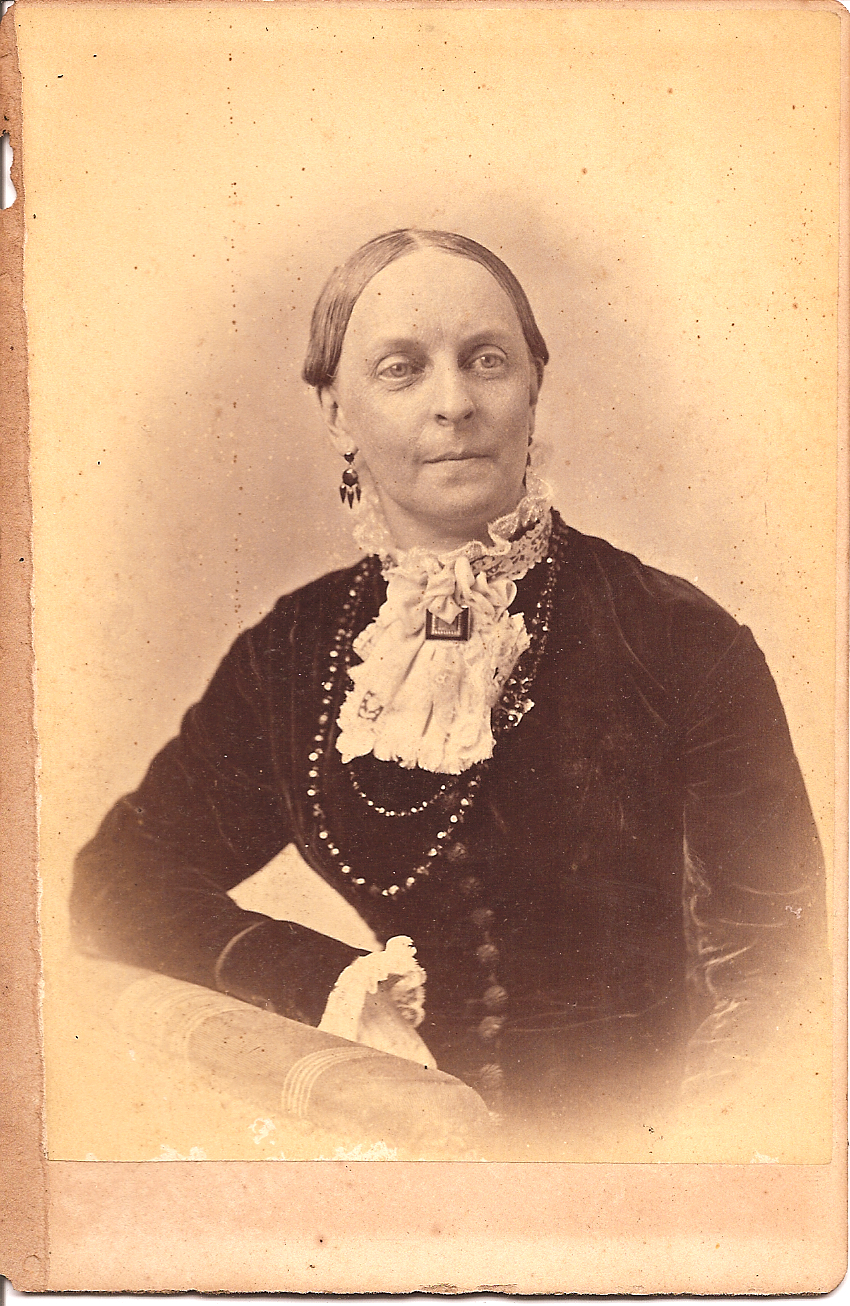
oldmissWith all the discussions these days about Syria and whether the United States should become involved in another Middle East conflict, I thought it would be interesting to read about the worries expressed by Catherine Kellogg Converse Frierson (7/3/1827 – 10/7/1899) in a letter to her grandson, James Nelson Frierson, about another military involvement of the U.S. – the Spanish-American War.

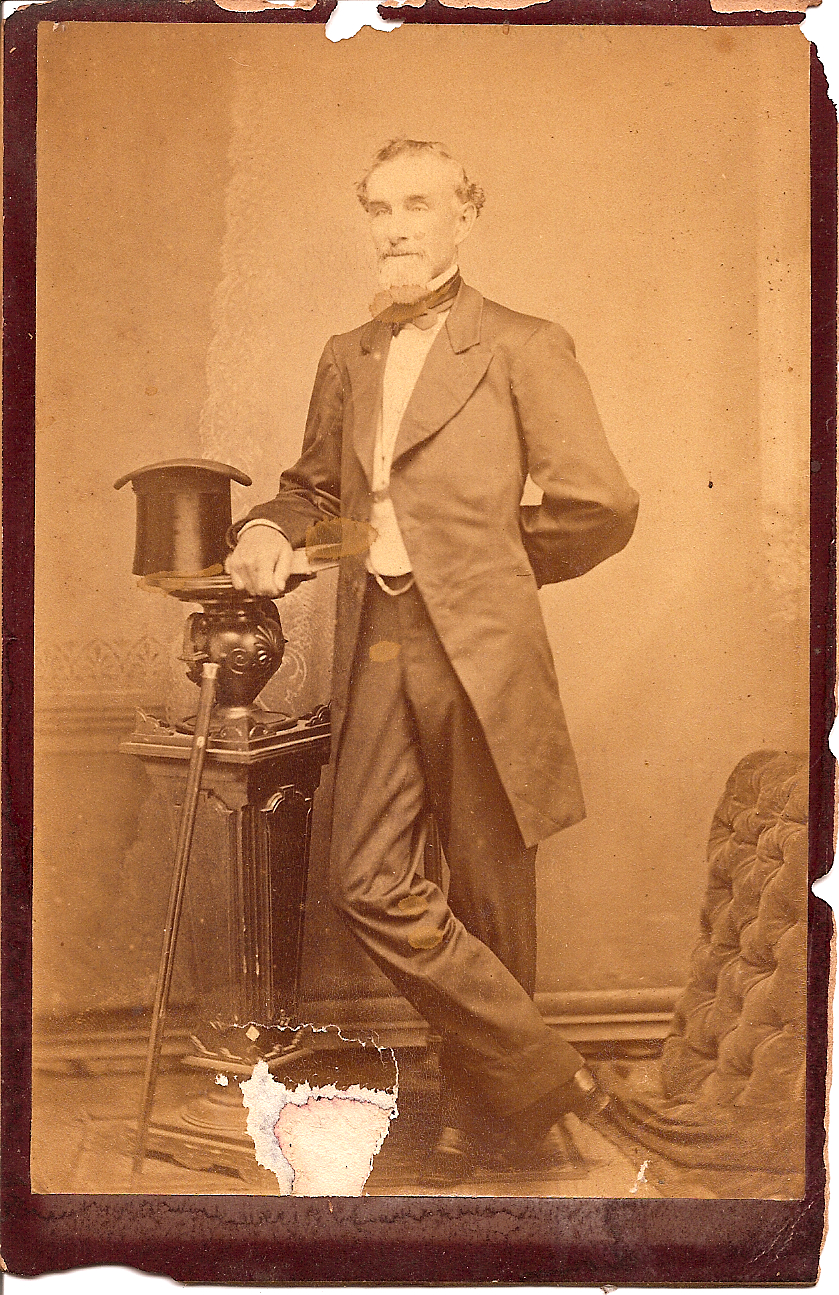
To the left is a photograph of my great-great grandmother, Catherine Frierson, and to the right below is her husband, John Napolean Frierson (2/21/1818 – 2/19/1887).johnn
She was the daughter of Mary Ann Kellogg Converse (5/2/1805 – 1/9/1848) and the Reverend Augustus Lawrence Converse (11/21/1798 – 3/21/1860) who was rector of the Episcopal Church of Claremont in Stateburg, S.C., from 1827 until 1850 and then of its present-day replacement Holy Cross Episcopal Church from 1850 until his resignation in 1853.   Reverend Converse was quite a controversial (some might legitimately say criminal!) character in our family – there will be much more to say about this fellow in a later post!

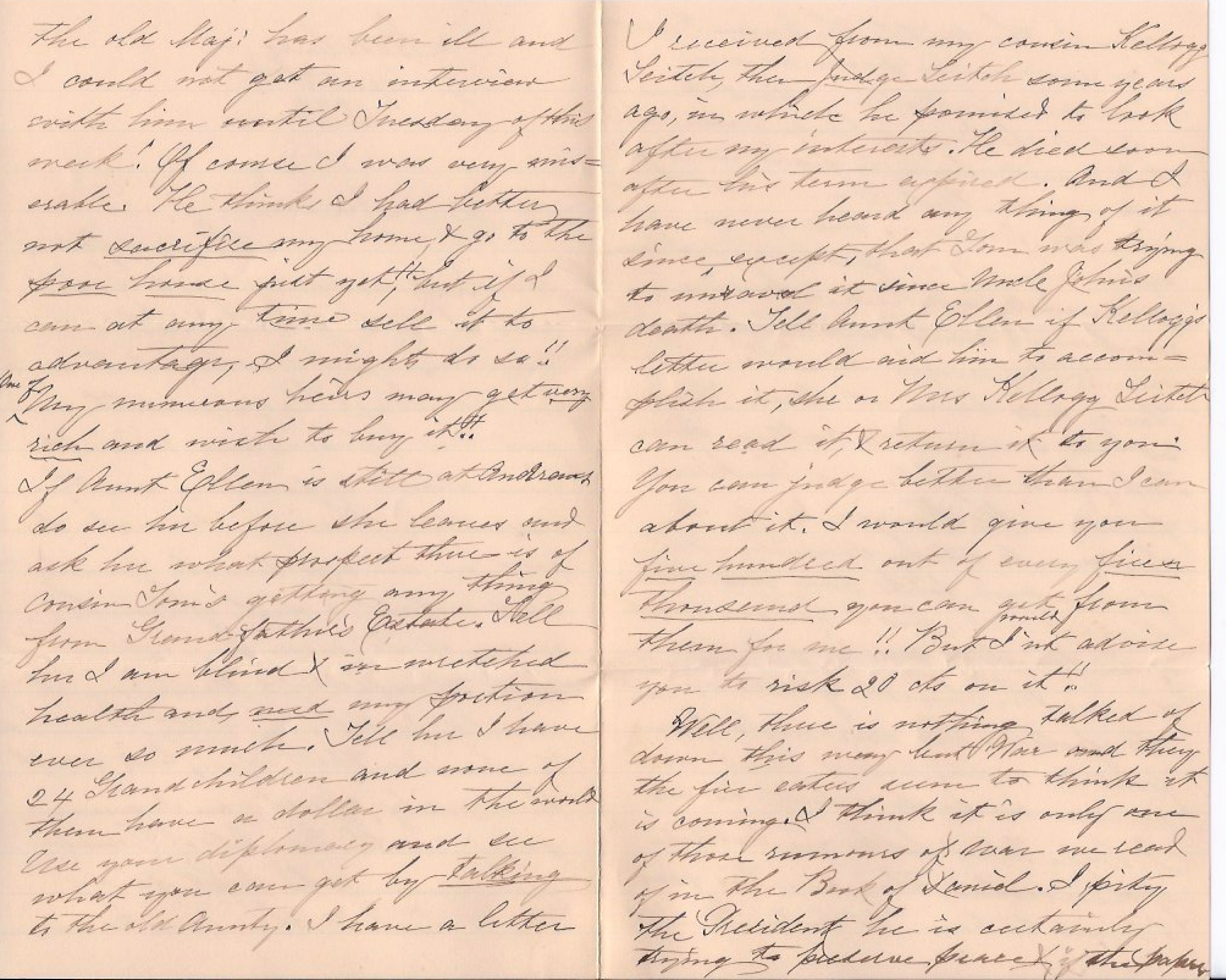
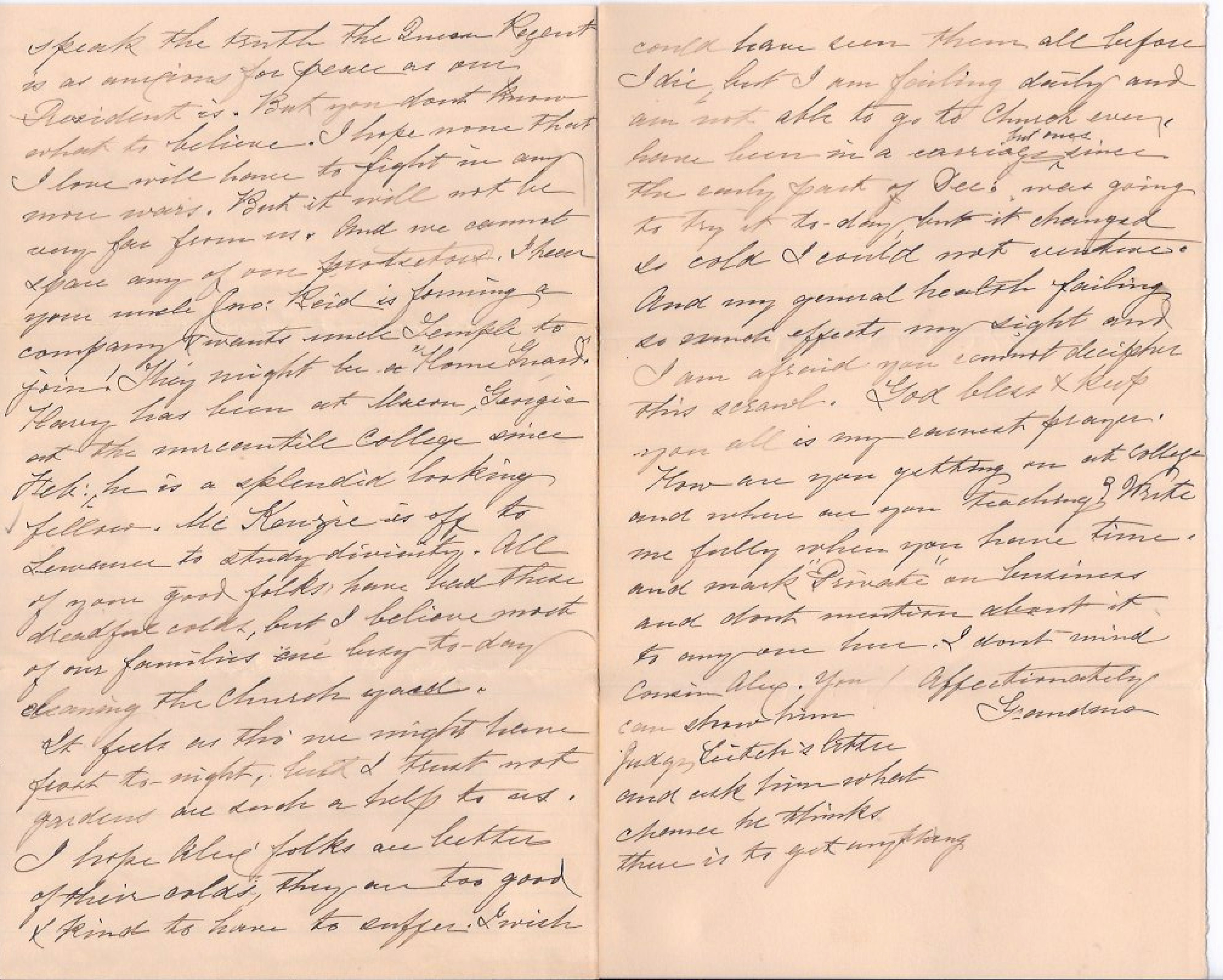
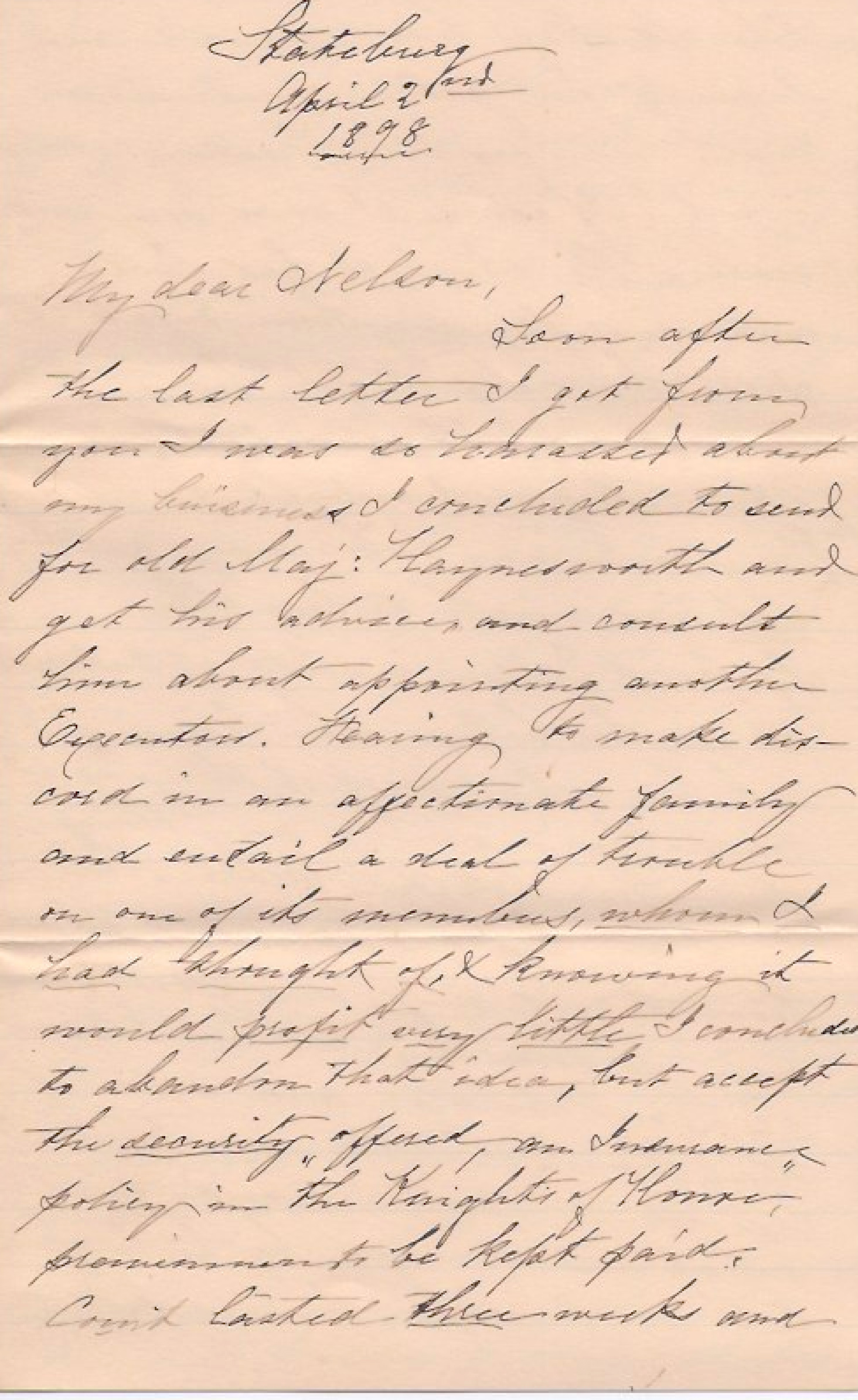
Uncle Nelson kept a folder of three letters written to him in 1898 from his grandmother Catherine.  They tell him of her worries about her health (she would die less than 6 months after the May 4th letter was written), about her estate including her plantation residence Cherry Vale, about the estate of her grandfather Daniel Kellogg (4/19/1780 – 5/4/1836), a very wealthy New Yorker who had died many years earlier and whose estate was still under litigation, and the war talk following the sinking of the USS Maine in Havana Harbor in February of 1898.  She seemed to be seeking advice about legal issues from her grandson who was “up North” in school studying law and in contact with her relatives – the full letter of April 2, 1898, is given in the figures below and I’ll quote from pages 3 and 4.

“… Well, there is nothing talked of down this way but War and they the fire eaters seem to think it is coming.  I think it is only one of those rumors of war we read of in the Book of Daniel.  I pity the President he is certainly trying to procure peace and if the papers speak the truth, the (illegible – Queen??) Regent is as anxious for peace as our President is.  But you don’t know what to believe.  I hope none that I love will have to fight in any more wars.  But it will not be far from us.  And we cannot spare any of our protectors.  I hear your uncle Jno Reid is forming a company and wants Uncle Temple to join!  They might be a “Home Guard”… ”

And from the letter of May 4, 1898:

“… Nothing is talked of now but war and I see by the papers we have gained a great victory!  I can’t for the life of me tell what we are fighting for.  Not for starving Cubans when they are fighting in the Phillipine Islands!  I pray that none of my loved ones will have to go to Cuba to get yellow fever.  We are surrounded now by Smallpox….  I begin to think that Profess (illegible) and old Dr. Anderson are right, certainly the end must be near.  ‘The signs of the times’ indicate it.  ‘Famine and pestilence’ and war at our very doors, and rumors of war at every point.  Does Cousin Alex think it will last long?  I never expected to see another war but I was thankful it was not a fratricidal one like the one in 1860, but the blue and the gray will be side by side again fighting for the same flag.”  

She ends this May 4th letter with:  “ … Lovingly, Grandma.  I am very blind and very feeble.  Groceries have risen enormously and we shall have to live on corn bread and potato coffee!”
KatherineFrierson1

KatherineFrierson2&3KatherineFrierson4&5

Friersons in South Carolina

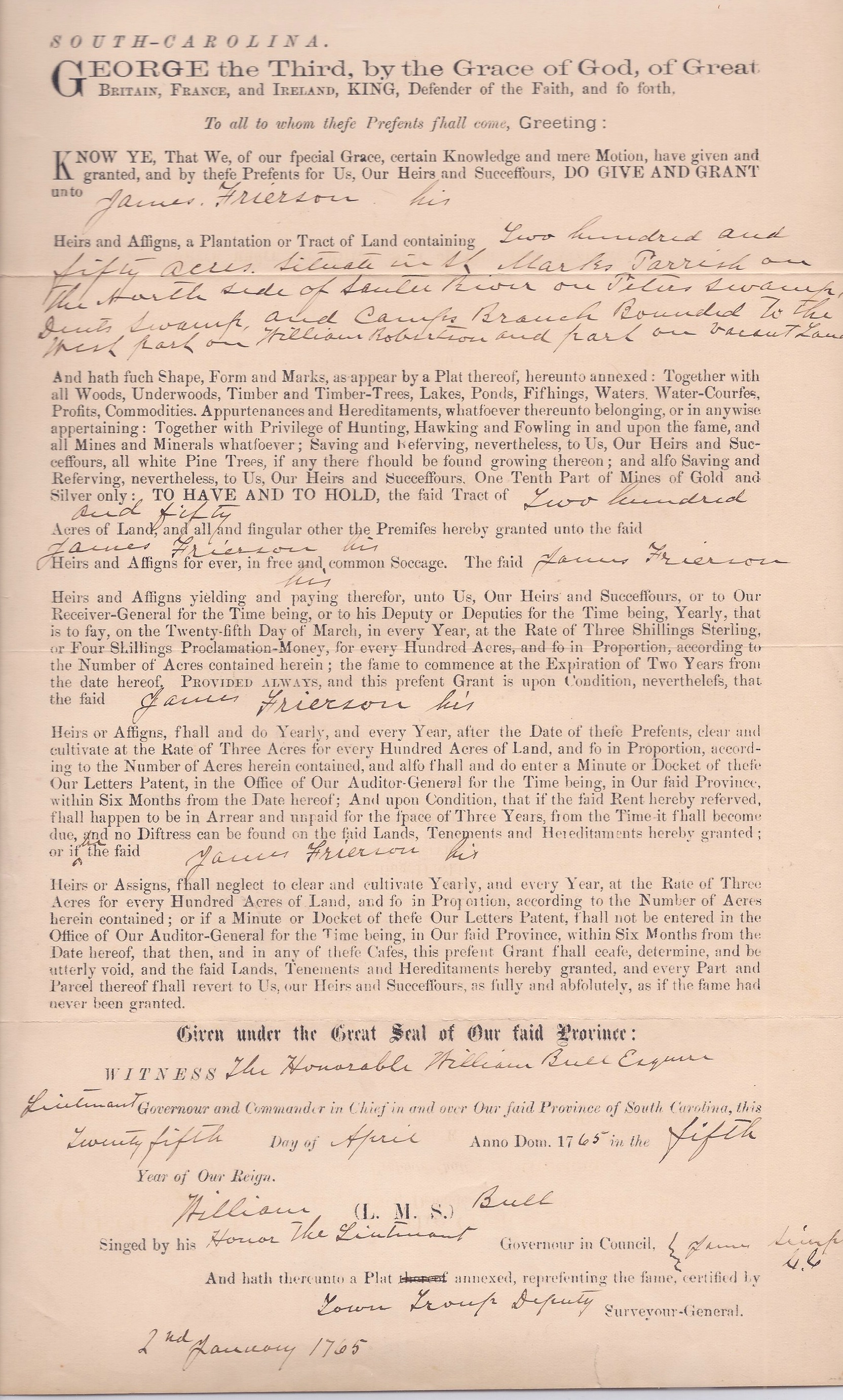
Our Frierson family has been in South Carolina since at least the mid-eighteenth century.  The land grant shown below from King George III of England to James Frierson in 1765 grants him “250 acres situated in St. Mark’s Parish on the North side of Santee River on Titus Swamp, Dents Swamp, and Camps Branch Bounded to the West part on William Robertson and part on vacant land”. 

Land Grant to James Frierson, April 25, 1765

Land Grant to James Frierson, April 25, 1765

This James Frierson (d.~1785) is my great-great-great-great-great grandfather and his property is very likely part of the land that in the early 1940’s was inundated by the Santee Cooper Project which built hydroelectric dams to form Lakes Marion and Moultrie and bring electricity to several of the counties in this part of South Carolina.  Lake Marion is fed by the Santee River and Wyboo Creek and others and now covers acres of property owned by some of the earliest settlers of SC, including the Friersons.

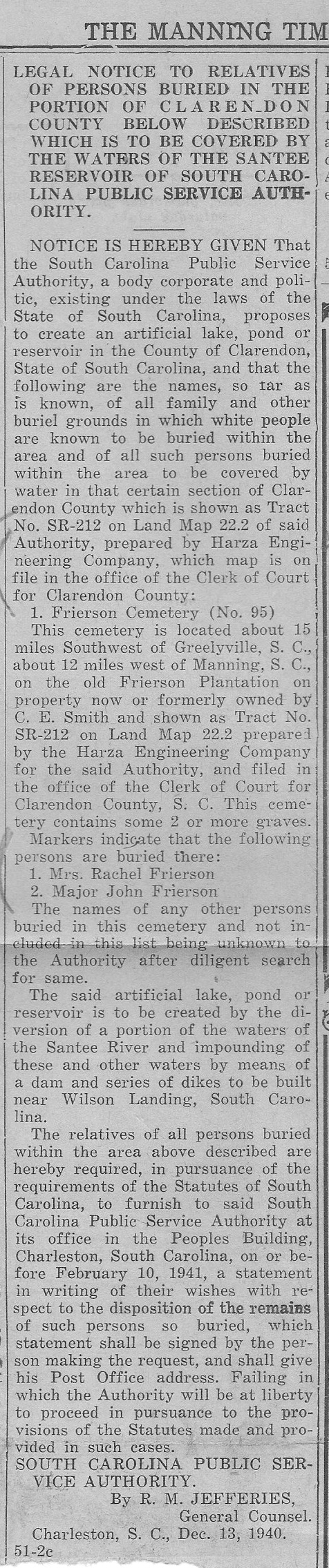
In the late 1930’s and early 1940’s, as the hydroelectric project was being planned, surveys were made of the historic homes to be destroyed by the lakes (see the Waterman report from 1939 at http://www.rootsweb.ancestry.com/~scbchs/Waterman.html  and the article by F. M. Kirk on plantations to be flooded at http://www.rootsweb.ancestry.com/~scbchs/plantation5.html ).  ManningTimesAlong with flooded homes, it was realized that many cemeteries would also be covered by lake waters and attempts were made to find nearest kin who might have interests in the graves.  Starting in 1938, letters of James Nelson Frierson, (Uncle Nelson of the previous post below) show his interest in a particular graveyard attached to the old Wiboo Plantation formerly owned by ancestors of our Frierson family.  As the Santee Dam neared completion, the SC Public Service Authority began advertising graveyards that would be affected by the rising waters.  One such notice is shown to the right  from the Manning Times of December 25, 1940.

Nelson’s first and most descriptive letter on the subject of these graves is written to Mrs. Waites Rees (nee Julia Vaughn Frierson ( 1859-1944)).  She was the daughter of Nelson’s great-uncle James Julian Frierson (1832-1899).  James Julian Frierson was the younger brother of John Napolean Frierson (1818-1887), my great-great grandfather and these two planters owned much property in Sumter/Clarendon County.  Nelson describes in this letter, written on July 21,1938, a visit he made to the old graveyard as follows:

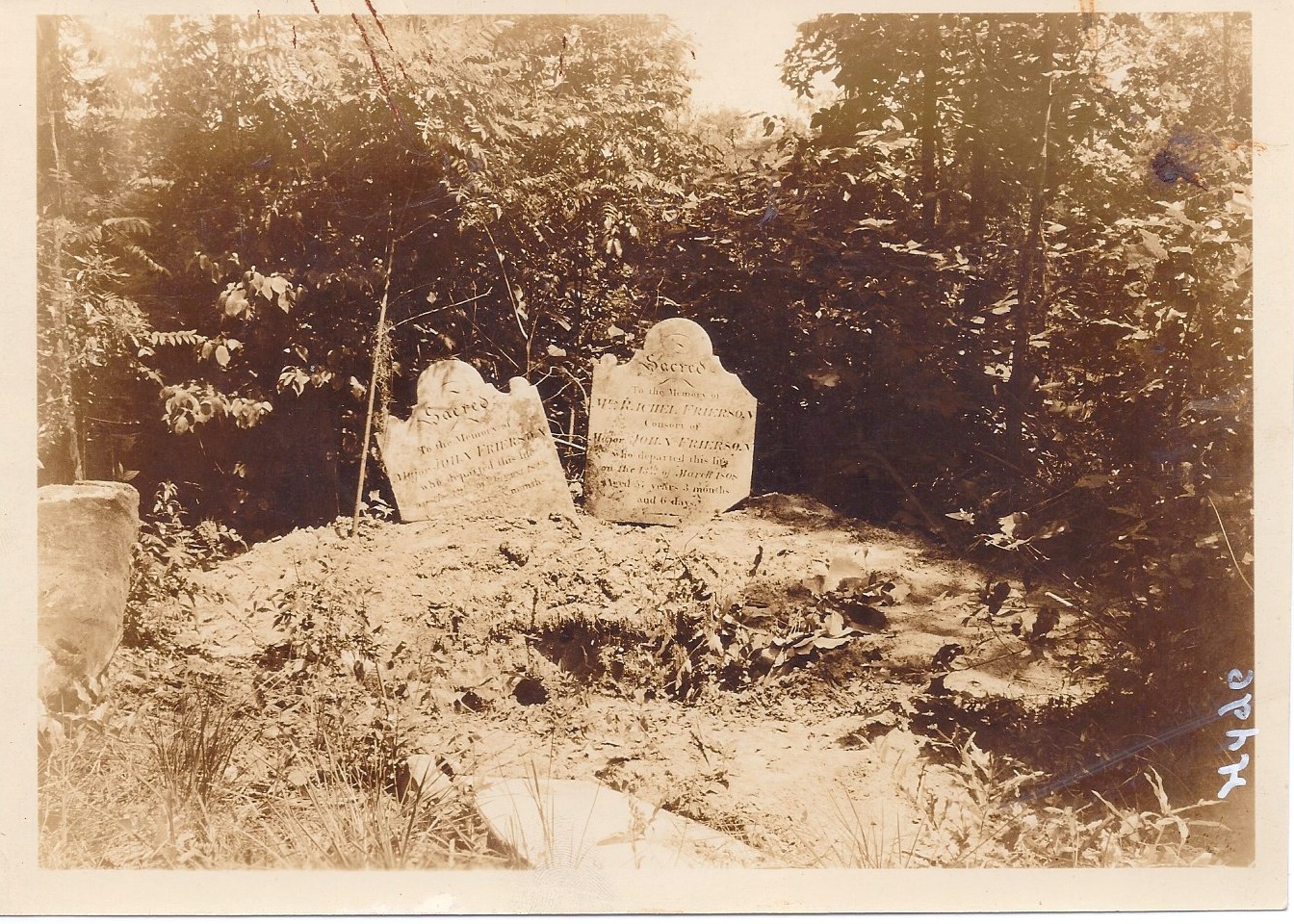
Tombstones Wiboo, 1939

Tombstones in Frierson graveyard, Wiboo, 1939
Photo by S. L. Hyde of Santee-Cooper Authority

 “My dear Cousin Julia:  Last Sunday, July 17th, at his request, I accompanied my brother John Frierson (John Lawrence Frierson (1883-1963), my grandfather, we called him “Papa”) down to view the old Frierson graveyard in the swamp back of Wiboo.  John’s oldest son, Jack (John Lawrence Frierson, Jr. (1915-1994), my “Uncle Jack”),  and also John’s brother-in-law, Oliver Plowden (“Uncle Oliver”), accompanied us on the trip.  It was a very hot day but we felt well repaid for our troubles.  We first drove by Wiboo place and I was much saddened to see only the three gaunt chimneys standing of the old house in which I visited in the late fall of 1890.  … When we got to the old graveyard we found only two gravestones.  There were apparent evidences of other graves having been there but there were no other stones, and the two that we found were broken and lying on the ground.  The graveyard is surrounded by an old ditch and consists of about a quarter of an acre.  A very old live oak tree stands in the middle of the enclosure, but it is a mere shell, gutted by fire and will not be standing very long.  I copied the two inscriptions and they read as follows:  ‘Sacred to the Memory of Major John Frierson who departed this life on the 10th day of August 1825 Aged 68 years ? months and ? days’  (the number of months and days are obliterated on the stone).  ‘Sacred to the memory of Mrs. Rachel Frierson Consort of Major John Frierson who departed this life on the 13th of March 1808 Aged 57 years 3 months and 6 days’.  

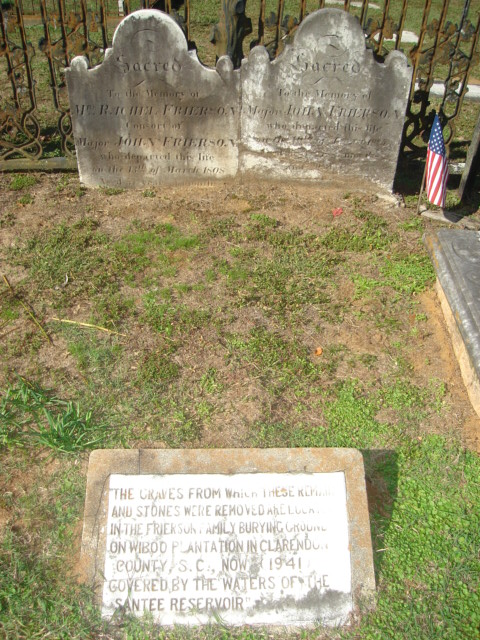
 I do not know whether the old graveyard will be covered with water after the lake to be formed under the Santee-Cooper project shall have filled or not.  But I am convinced that if the land will not actually be covered with water, it will undoubtedly be surrounded with water so as to be inaccessible.  Under these circumstances I think that it will be very fitting and proper to have these two broken tombstones removed to the old Frierson enclosure at the rear of the Church of the Holy Cross in Stateburg and have them set up there, with perhaps an accompanying statement to the effect that ‘the graves from which these stones were removed in the month of —, 1938 are in the old Frierson burying ground on Wiboo plantation, Clarendon County, South Carolina’.

Holy Cross Church

Holy Cross Church, 2006


 If this is done, the stones in the one enclosure at Stateburg will show an unbroken line from Major John Frierson of the Revolution down to the present time.  What are your views and wishes concerning ther removal of the two stones?  My hope is that we may be able to get the Santee-Cooper Authority to bear the expense of removing the tombstones from their present location to the Church at Stateburg and perhaps bearing the expense of setting them up there.  I sincerely hope that you and Honor and all her children are well and that I may have the happiness of seeing you before very long.  With love to yourself and Honor and hoping to hear from you soon, I remain Your affectionate cousin, J. Nelson Frierson.”

By the time the Santee dam was completed in 1941 and the river began to flood the area, the graves had been moved to the Frierson-Vaughn enclosure in the Holy Cross Church in Stateburg, S.C., and they remain there today as you can see from the photo above.

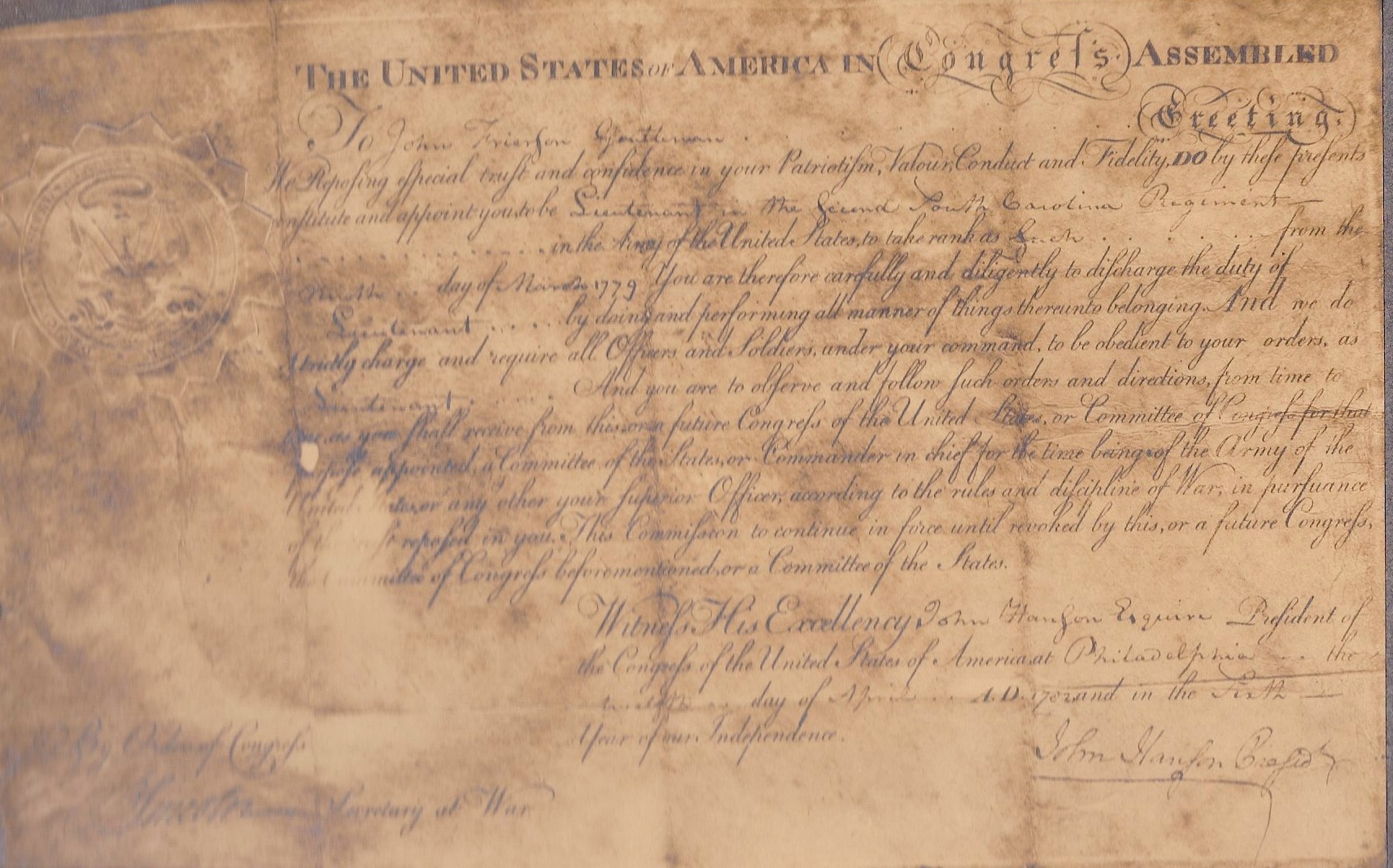
Major John Frierson (1757-1825) and Rachel Davis McDonald Frierson (1751-1808) are my great-great-great-great grandparents.  He was the oldest child of the original grantee James Frierson  and was commissioned in 1779 as Lieutenant in the Second South Carolina Regiment of the Continental Army.  His commission is shown here, signed by John Hanson of Maryland, first president of the Continental Congress.

Commission as Lieutenant

John Frierson’s Commission as Lieutenant in the Second SC Regiment of the Continental Army

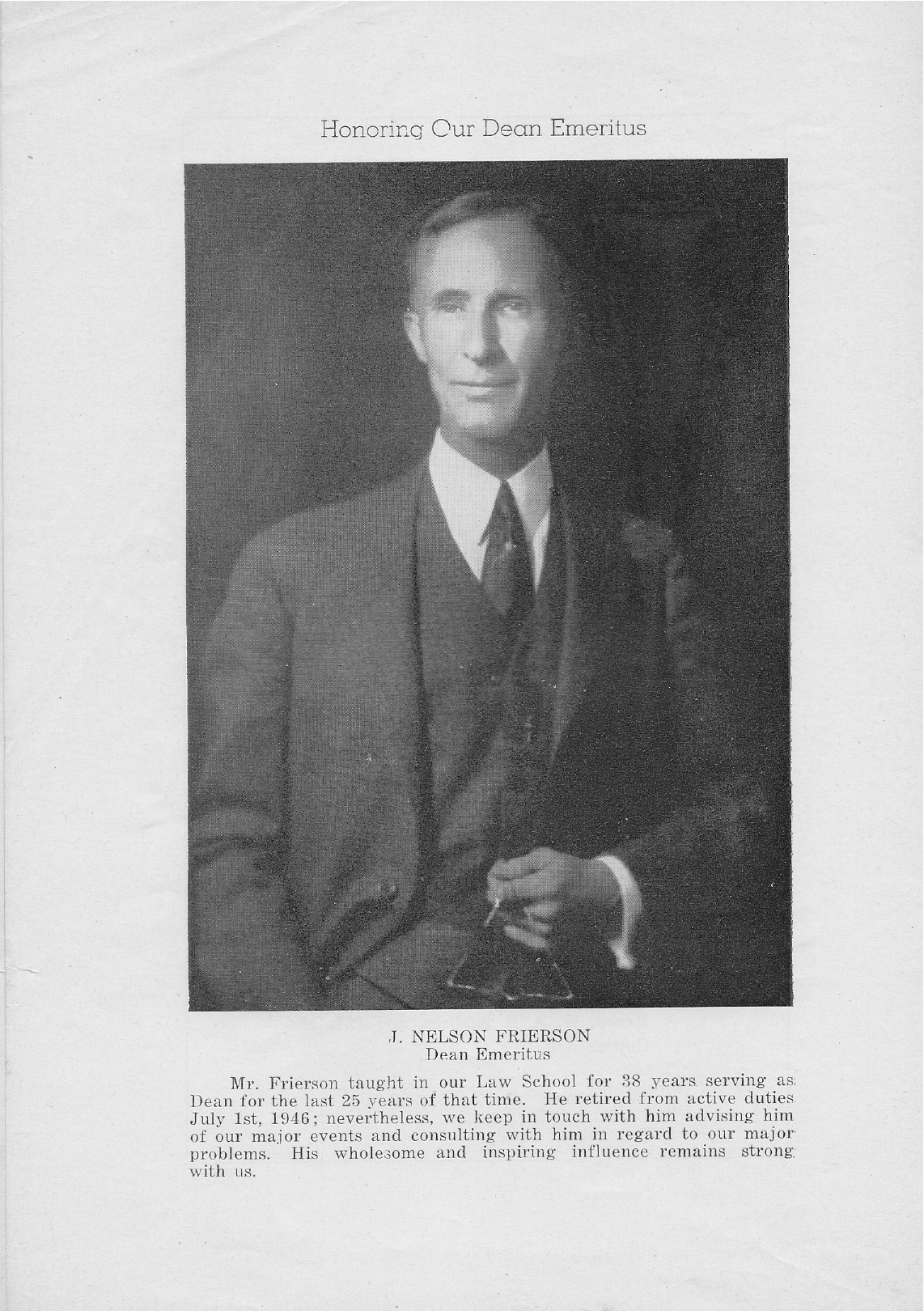
James Nelson Frierson


JNFPortrait

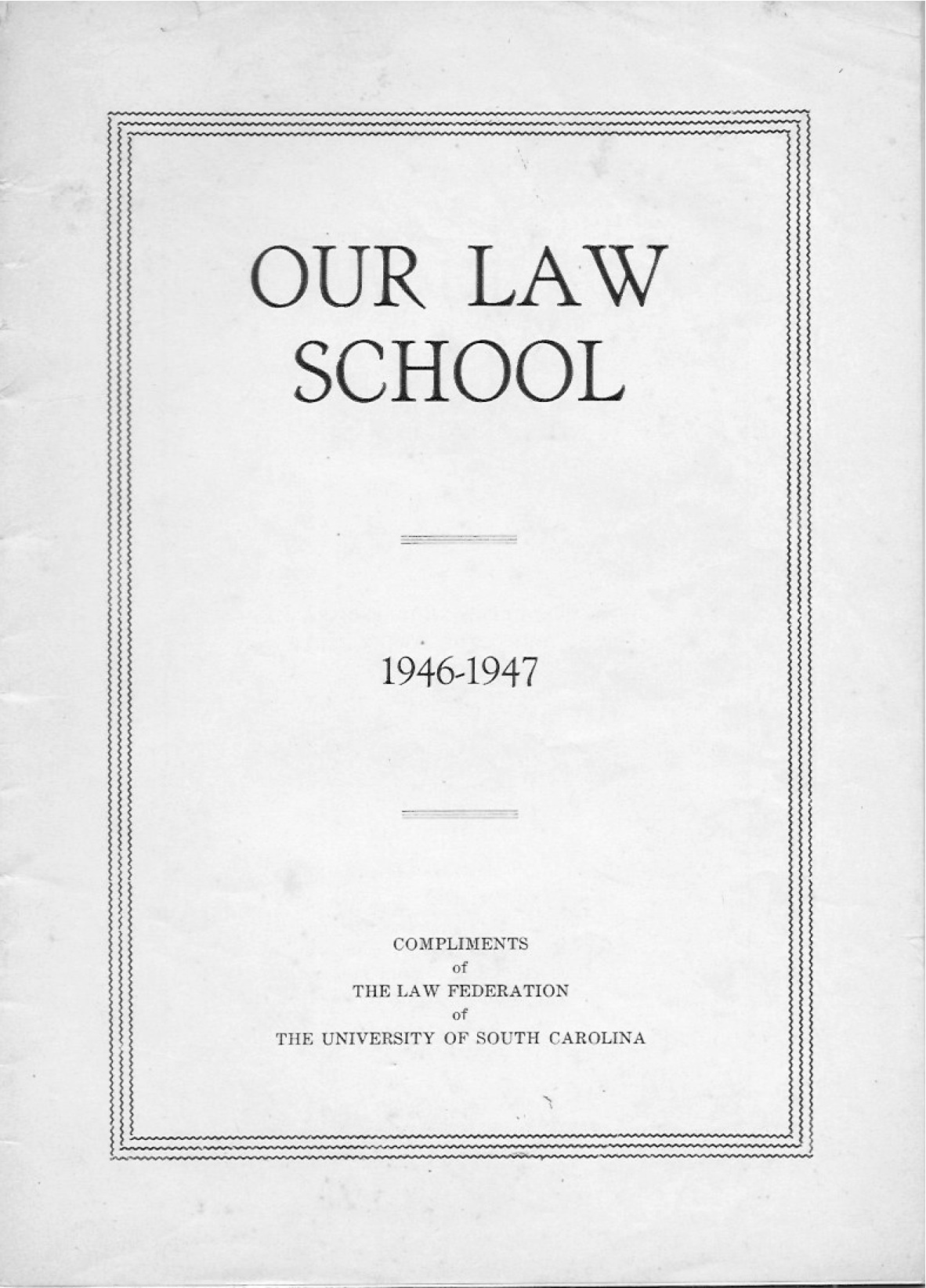
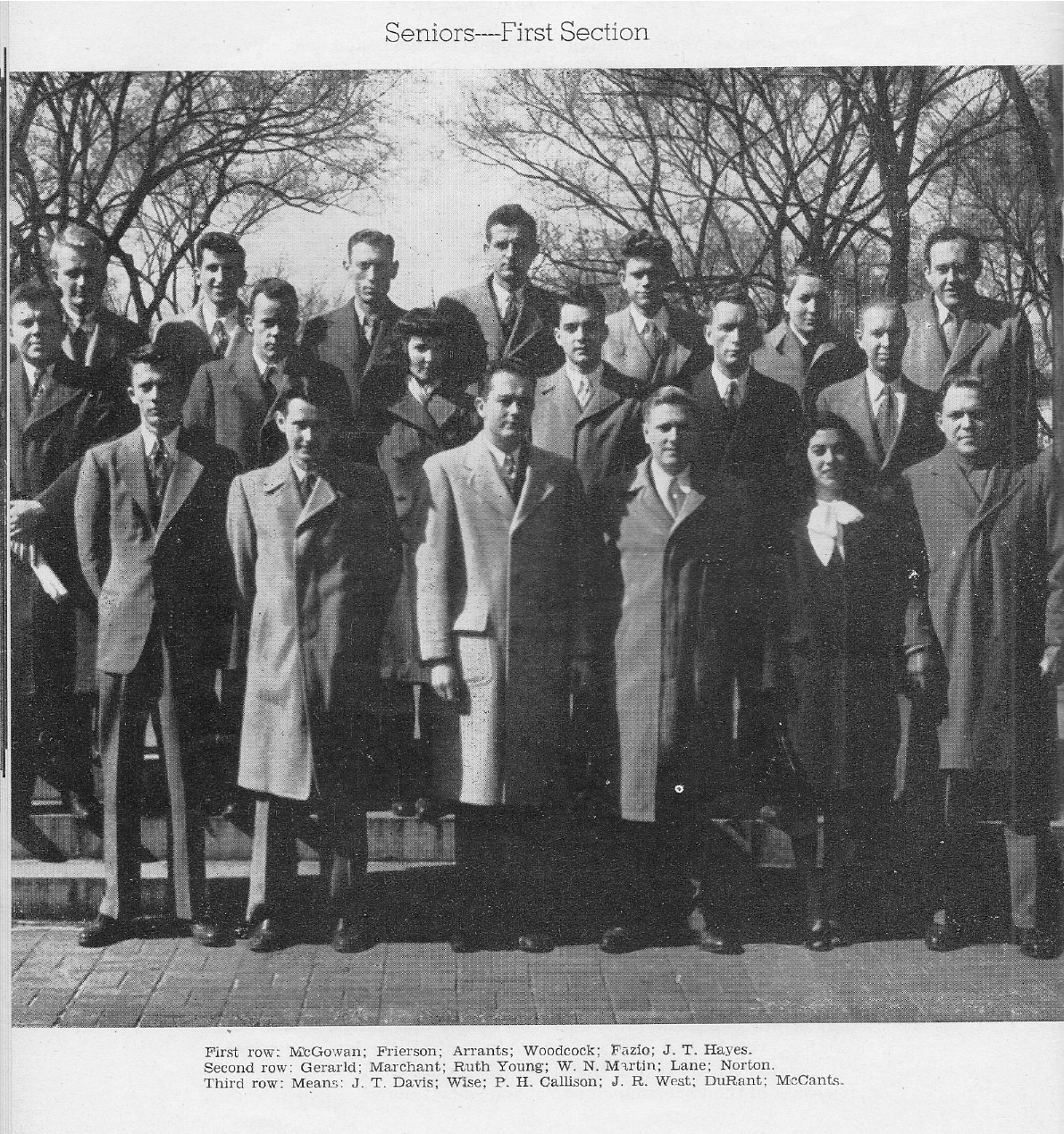
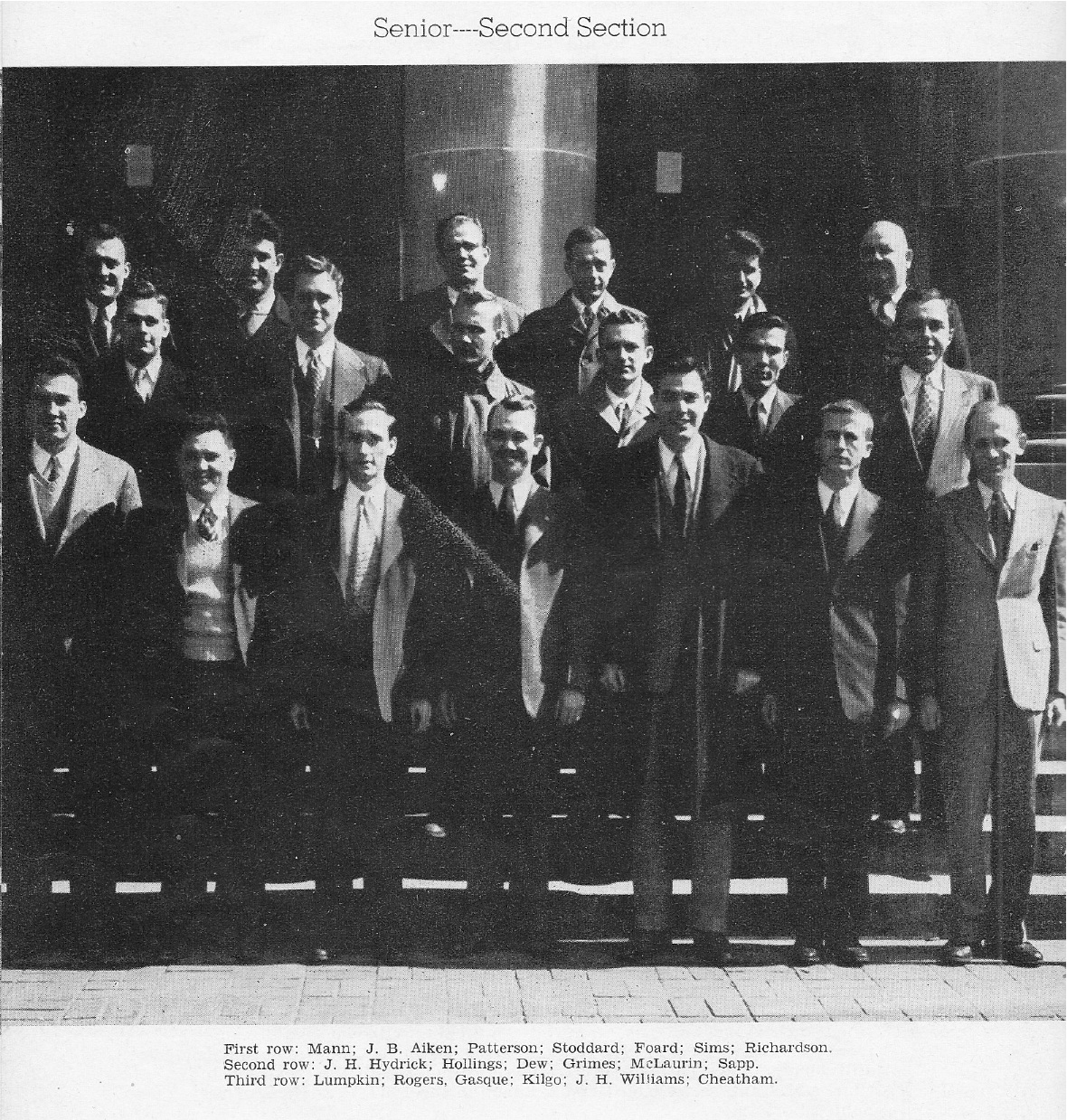
James Nelson Frierson (1874-1960) was Dean of the University of South Carolina Law School from 1920 until his retirement in 1946.  He had returned to South Carolina to teach law in 1908 after practicing in Buffalo, NY, following his graduation from Columbia University (New York, NY) Law School in 1899.  Uncle Nelson, as we all called him, was my grandfather’s (John Lawrence Frierson (1883-1963)) oldest brother and it is through Nelson’s diligence in saving and collecting family papers that I will be able to put together many of the articles that will appear on this site.   The photograph to the leftOur Law School, page 1 shows Dean Frierson in a publication of the USC Law School called “Our Law School, 1946-1947”.  The publication has a historical sketch of the Law School and photographs of the students attending the law school at that time.  Additionally, a complete list of all the graduates from 1868-1946 is given along with a list of all law faculty members and their dates of service.  Several pages of the publication go under the title “Something of Our History” by E. F. Hollings, parenthetically subtitled “If You are Allergic to Nostalgia, Don’t Read This” !  E. F. Hollings of course is Ernest Frederick (“Fritz”) Hollings, a senior law student pictured in the Second Section photograph below, later to become Governor of South Carolina (1959-1963) and U.S. Senator (1966-2005).  Another famous senior law student pictured in the First Section photograph below is my father, George Dargan Frierson.

George Dargan Frierson, First Row, Second from the Left

G. Dargan Frierson, First Row, Second from the Left

E. F. Hollings, Second Row, Second from the Left

E. F. Hollings, Second Row, Second from the Left


My first cousin, John Lawrence Frierson III, told an interesting story this past week that Mr. Hollings, related to him about Dean Nelson Frierson.   Lawrence bumped into Mr. Hollings at a retail establishment in Charleston recently and after introducing himself, he thanked him for his service to the state of South Carolina.  Mr. Hollings asked Lawrence to repeat his name, and then said, “Are you related to Nelson Frierson, who was the Dean of the University of South Carolina Law School?”  After hearing that Nelson was Lawrence’s great-uncle, Fritz related (in his characteristic Charleston low country accent!) a detailed account of how upon his return from  World War II, he was two weeks late in applying for admission to the Law School.  But after a personal meeting with Dean Frierson, who heard Fritz’s story during that interview, he was admitted by special handwritten note from Nelson!   “Take this note down the hall”, Nelson said… and Fritz Hollings was able to attend the Law School without delay.   “Dean Frierson made it possible for me to go to Law School that year and I’ve always appreciated the help he gave me at that critical time of my life!”